We just spent a wonderful four days in Hong Kong.  Although I’ve loved nearly all of the places we’ve visited so far, this was the first one since Paris where I could actually picture myself living.  It felt to me a lot like an Asian Manhattan, and I have to say, the familiarity was kind of refreshing. 

Our time in this British-colony-turned-special-administrative-region-of-China was a delightful mix of regular-life activities and touristy ones.  We sat in the park.  I went running.  We saw a movie.  It was almost the stuff of an ordinary weekend at home. 

Of course, we also made sure to do some things that were unique to Hong Kong.  On Saturday night, we went out in a very popular, very cosmopolitan area that–to add some validity to my Manhattan comparison–is known as SoHo.  We stumbled upon a street fair full of revelers from all over the world where vendors were peddling everything from Russian food to tarot cards.  We happily let the crowd’s momentum carry us through the narrow streets and, when we got tired of all of the jostling, we paused for what turned out to be a great dinner of ribs (Derek) and crab legs (me). 
Hong Kong Harbor
The next day, after an amazing dim sum brunch that warrants its own post, we took a ferry to Kowloon, the part of Hong Kong that sits on mainland China.  (The rest of Hong Kong is dispersed over more than 230 islands (really!), although Hong Kong Island, where we stayed, is by far the most populated among them.)  Once the sun went down, we had an amazing view of Hong Kong Island’s technicolor skyline, which was itself enough to warrant toting our tripod all the way from Nashville! 
View from Victoria Peak
Yesterday, we took a tram to the top of Victoria Peak, a mountain that springs up right in the middle of Hong Kong Island’s urban chaos.   We hiked around the peak’s summit and, despite the smog that’s all too typical in Hong Kong, got some pretty good overhead views.  Our path back down the peak took us through lots of neighborhoods that seemed far removed from the normal tourist route.  It was rush hour on a Monday evening, and we paused for a moment to watch all of the harried commuters and to marvel at the great freedom that comes with a year of unemployment. 

As discussed in a prior post, Macau was a Portuguese colony for almost 450 years, only becoming a semi-autonomous part of China in 1999.  During this time, the Portuguese left an obvious mark on Macau.  We took a taxi from our hotel to Largo do Senado, a square in the heart of the historic district.  The Portuguese influence is immediately seen in the architecture of the beautiful buildings and churches surrounding the square.  We then meandered through the narrow streets of Macau passing many shops and restaurants. 
Main Square (Leal Senado) in Macau
We walked by several shops where employees were passing out free samples of some unknown meat product. I have an unblemished record spanning over 30 years of never saying no to a free sample (whether from a Chinese restaurant in the mall or some old lady at Kroger or Costco), and I definitely wasn’t going to end my potentially Guinness-breaking accomplishment simply because I had no clue what was being offered.
"Meat Sheets" - I had the pork.  Delicious!
I held out my hand and the young lady used her scissors to cut a piece of foreign meat from a rectangular “meat sheet”.  Within seconds of consuming my morsel, I was overwhelmed with the need to have more…NOW.  Without shame, I begged for another sample of the meat (which I believe was pork).  Realizing that 2 pieces was not enough, I broke down and bought a piece of the meat sheet.  The incredible taste is hard to describe; it’s most akin to jerky, but infinitely better.  I quickly swore that I would make it my lifelong mission to re-create the meat sheet in my own kitchen once we return to the States so Americans can share in the joy the meat sheet provides.
Church of St. Paul Ruins
After having my fill, we continued our walk until we reached the ruins of the church of St. Paul’s.  The church, which was built in 1602 by Japanese Christians who fled persecution in Japan, burned down in the mid-1800s.  All that remains is the facade of the cathedral and the crypt underneath (where bones of Japanese martyrs are displayed).  It is an eerie, yet beautiful reminder of the Christian religion that thrived here during the Portuguese era.  Some say it is the greatest monument to Christianity in all of Asia.
Awesome African Chicken at Restaurante Litoral
After getting lost and receiving directions from some very helpful Macanese locals, we found Restaurante Litoral – a well-known Macanese restaurant here in Macau.  We trusted our guidebook and ordered the African Chicken (chicken that is slowly cooked in a sauce that is a blend of chilies, garlic, coconut and other spices) and Baked Salted Codfish (a Portuguese speciality that is still loved in Macau).  If you’re a chef, try to find recipes for both of these dishes and put them on your menu.  They will both be bestsellers.  I can’t confirm this (but I’m fairly positive) that I saw a tear of joy in Shanna’s left eye as she tasted the salty goodness of the codfish.  I can usually trust her to share a good portion of her meal, but there was no chance today.  This was one of the best meals we’ve had on our trip.
Elderly Beggar at A'Ma Temple
Finally, we visited the A’Ma temple.  The temple was built on the site that A’Ma, a legendary woman who survived a terrible storm while on a ship, landed and then ascended into heaven.  The temple, which is built on the side of a hill, was filled with Chinese tourists offering money and incense to the shrines at the temple dedicated to various gods (including A’Ma, the goddess of seafarers).  It was an interesting site and a great way to end our visit to Macau.

Macau has an interesting history.  In the 16th century, the Portuguese began trading with the Chinese and, in 1557, were granted the small islands of Macau (located a few miles off the coast of China on the South China Sea) as a reward for driving away the pirates that inhabited the area.  It became a huge trading port of call for the West, but began a rapid decline when the British were granted the islands of Hong Kong (only an hour away by speedboat) in the mid-1800s.  Macau remained under Portuguese control until 1999 when it was handed over to China as a semi-autonomous region of China (similar to Hong Kong, which was handed over to China in 1997).  This semi-autonomous status allows the Macau government to control many of its own affairs without the supervision of mainland China (other than the areas of defense and foreign affairs).
its_kind_of2
One major act of the Macau government was to legalize gambling, an activity that is banned throughout China and Hong Kong.  The Chinese are notorious for their love of gambling.  Several Chinese-owned casinos have taken advantage of this in the past, including the historic Casino Lisboa.  It was only a matter of time before the West finally realized the opportunity in Macau, especially with the number of Chinese millionaires that have been produced by the incredible economic growth in China in recent years, earning Macau the nickname “Vegas of the East”.  In the past couple of years, the Sands Hotel and Casino and the Wynn Hotel and Casino (a huge name in Las Vegas) have opened their doors, and, in just the past two months, the Venetian Hotel and Casino opened as the largest casino in the world.  As you drive around Macau, you will notice many other hotels/casinos (including the Four Seasons, the MGM Grand and a Sheraton) under construction.  Macau is undergoing a major boom.
Casino Lisboa (old school casino in Macau)
As one of our wedding presents, some friends gave us a couple of nights at the Venetian Hotel (which was reasonably priced due to the grand opening).  When we checked in, we where overwhelmed by the size of the casino (much bigger than any casino I’ve seen in Las Vegas) and the size of our room (all the rooms are suites at the Venetian).  Our excitement was quickly squashed when the ATM we used ate my ATM card (ok, it was my own fault since I entered the wrong PIN number 3 times in a row, BUT I realized later – too late – that the way the numbers are arranged on Chinese ATM keypads are the exact opposite as in the US…you live and you learn).  The prospect of a few days (and maybe weeks) in China with no access to money was – to say the least – a little stress-inducing.  You’ll be happy to know that a few panicked phone calls and two visits to the local office of Banco Weng Hang the next day ultimately produced my ATM card, which I promptly kissed.
Venetian Hotel - Macau
The atmosphere of a Macau casino is dramatically different than one in Las Vegas.  First, it’s relatively quiet – they’ve turned off the sounds of the slot machines, and the Chinese (who are normally a very chatty people, from our limited exposure) are intense gamblers who don’t really talk or cheer while gambling (very different from the drunken outburts you witness at casinos on the Vegas strip).  We also noticed that the Chinese don’t drink (a notorious pastime in Las Vegas) while they gamble, creating a much different environment.  Finally, the games played in the casino are much different than in Las Vegas, with baccarat (which you’ve probably only seen in James Bond movies) and some game where you try and guess the sum of three dice that are rolled dominating the casino.  I can’t forget to mention how many tables the casino had of the game War (yep, the game you played as a kid where you simply draw a card and see if it’s higher than your opponent’s card).  It’s a 50/50 chance you’ll win, but – of course – the casino takes a huge percentage making the game a terrible bet.  Regardless, the War tables were packed with people lining up to grab an empty seat!

In my opinion, the real draw of Macau is not the casinos, but the historic colonial district of the Portuguese era and the great food.  I’ll talk about that later.

My negative encounter with one of the Eat, Pray, Love characters didn’t lessen my desire to track down the other.  Soon after we left Wayan’s, Derek and I set off by motorcycle in search of Ketut Liyer.  Given the morning I’d just had, I wasn’t expecting much.  Happily, Ketut proved me wrong.
Ketut Liyer

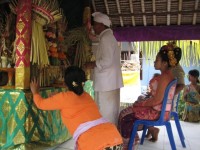
We arrived at Ketut’s house in time to see him dashing across his doorway in his skivvies.  A friendly man who turned out to be Ketut’s son instructed us to wait on the front porch.  Soon, a half-dressed Ketut emerged and, with a broad smile that showed off his few remaining teeth, warmly welcomed us to his house.  As he robed himself in the traditional clothing of a medicine man, he invited us to accompany him to a marriage ceremony at which he was to bless the offerings made to the love gods on behalf of the newlyweds.  Clearly, we accepted his invitation.

Ketut performing wedding ceremonyA short walk later, we arrived at an altar piled high with sweets and baskets of fruit.  The bride and groom, who were seated in front of it, smiled at us warmly.  Someone handed us plates of wedding cake and bottles of warm Coke.  This is not how we would have treated tourists who barged into our wedding and started madly taking pictures.  We were amazed at everyone’s hospitality and at our own good fortune.
Derek and Ketut Liyer
After Ketut had finished his ceremonial duties, which largely seemed to involve chanting melodic prayers and ringing a hand-held, gold bell, he invited us back to his porch, where he proceeded to read our palms, our faces, our legs, our necks and our backs.  After this thorough inspection, I’m happy to report that Derek and I are going to live to be 102 and 101, respectively, that we’re blessed with both intelligence and good luck and that, someday, we’ll be very wealthy.  (I wish that I hadn’t read that he says this to everyone, but I choose to believe him, anyway.  Who am I to question a medicine man who may himself already have reached age 102?)


We declined Ketut’s pleasant offer to buy one of his paintings for $200 US (surely Eat, Pray, Love has allowed him to boost his prices a bit) and left his house with our faith restored.

As I mentioned in an earlier post, I read Elizabeth Gilbert’s “Eat, Pray, Love” at the beginning of our trip.  For those of you who haven’t read the book, it tells of the author’s year of travels through Italy, India and Bali.  Like us, she spent most of her time in Bali in the city of Ubud, where she befriended both a traditional Balinese healer named Wayan and an old medicine man named Ketut Liyer.  Both Wayan and Ketut seemed to me to be of a Bali from long ago–one that I very much wanted to learn more about.  I arrived in Ubud determined to track down both of them and was happy to see that Ms. Gilbert had made the task significantly easier by posting their addresses on her website.
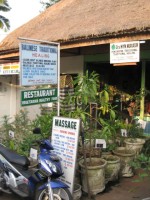
Wayan's Place from Eat, Pray, Love
Happily, Wayan’s shop was walking distance from our hotel.  We dropped by on Saturday afternoon and, within a few minutes, we were sitting with her at her shop’s only table drinking tumeric juice with honey (“for strength,” she said).  As a sort of preview of her services, she gave us a quick once-over and then listed a few of the things that ailed us.  I should have been suspicious when, after looking at Derek’s fingernails, she pronounced that he needed to eat fewer sweet things (the man loves food more than anyone I know, but he’s definitely not a dessert eater), but I was breathlessly excited to have met the woman who, in the book, had cured an infection normally remedied by a week’s worth of antibiotics using only some herbal compresses.  I made an appointment to meet with her for two hours on Monday.  Derek, who was more skeptical, particularly when he heard the price (more than double what the other “healing shops” charged), passed.
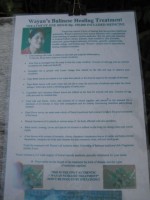
bad_medicine_3
When Monday morning came around, I arrived in Wayan’s tiny shop expecting to be amazed at her abilities and newly convinced of the healing powers of herbal remedies.  When I left three and one-half hours later, I had received only a sobering illustration of the destructive powers of the popularity that came to her after the book’s publication.  (I’m sure the same fate has befallen countless vendors who find themselves listed in the Lonely Planet or other guidebooks and, therefore, on most Westerners’ short list of acceptable places to frequent).
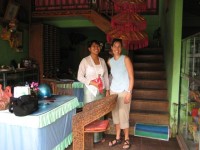
Wayan - the Balinese Healing Woman
For fifteen minutes, Wayan provided me with a list of my ailments that was quite similar to the one she had given me two days before.  It reminded me of a horoscope, in that it was vague enough to avoid being inaccurate (“you sometimes have a busy mind”) and general enough to apply to just about anyone (“you need to drink more water”).  She supplied me with a bag full of pills, potions and powders, one of which promised to address everything from diabetes to “new and old paralyzed” to “finishing the nasty smell of mouth and nose,” as well as a schedule of when to take what.  She then directed me to go upstairs.

Wayan had explained earlier that the book’s popularity had caused her business to boom and had necessitated the hiring of two assistants, a woman who looked to be about 18 and a man in his 20s.  These two met me upstairs and proceeded to rub me with betel leaves, rice mixed with galangal root, aloe vera and, at one point, pieces of a cucumber.  The treatments weren’t accompanied by any explanation.  While I found myself wondering both whether Wayan was coming back (I’d understood my appointment to be with HER) and why someone was rubbing cucumber in my eye, the experience was not altogether unpleasant.

The assistants then directed me to lie face-down on a massage table.  (What? Language barriers prevented me from pressing them for more information.  I definitely had not signed up for a massage, but ok….)  I did as instructed, and then things got confusing.  I was left alone with the male assistant, who, in a nutshell, began acting inappropiately.  (Don’t worry, Mom, nothing criminal or even very serious happened.)  I left Wayan’s shop as soon as I could and hurried back to the hotel with the events of the morning replaying in my mind.  

After reflecting more fully on the experience, I returned to Wayan’s shop a few hours later with Derek in tow and confronted Wayan about what had happened.  To her credit, Wayan appeared to be both appalled and surprised at her employee’s behavior.  What she said by way of an explanation gave me an important insight into both the depths of her beliefs and the corrupting powers of the fame that had come to her.  According to her, the man’s actions had been caused by evil spirits born of the jealousy of other Balinese people over her good fortune.  Her popularity meant that she had too many clients to handle so, when she saw me that morning, she had been too drained to provide any healing and had instead needed to relegate me to her assistants.  She was sorry; she would deal with her assistant; she was so, so sorry.  Both Derek and I noticed, incidentally, that she never offered to refund my money.  I had come to her shop in search of an “authentic, Balinese experience” (perhaps this fact alone reveals my naivete).  I left disillusioned. 

Ubud is known as the cultural center of Bali.  When I visited here in 1996, it was a fairly quiet town with a few restaurants and shops.  Since then, it has grown dramatically.  However, it hasn’t lost its charm – dozens of art galleries and woodworking shops are scattered thrroughout the town and rice paddies are less than a mile away. 

We decided to stay in the city instead of at one of the many hotels built directly in the rice fields. 
monkeying1
This has allowed us to explore the city, but hasn’t allowed us to see much of the surrounding area.  So, yesterday we rented a motorcycle (ok, it was more like a moped, but no one wants to admit to riding one of those).

Within a few minutes, we were in incredibly green rice fields where the local farmers were harvesting the rice.  I haven’t been able to properly photograph the “greenness” of the fields, and I’m not sure any cameras are out there that can really capture it.  It is striking.  If there are any photographers reading this, any advice would be greatly appreciated.

While driving through a small village, we came upon a large group of men and women in the middle of a Balinese ceremony.  They were wearing traditional dress and playing music as they walked along the village street.  We never did find out what the ceremony was all about.  It was a little awkward photographing their ceremony, but they didn’t seem to mind. 

Next, we came upon the Sacred Forest Monkey Sanctuary. 
Sacred Monkey Forest Ubud
My first thought was – tourist trap.  You’d walk in the forest and maybe see 1 or 2 monkeys.  Wow – was I wrong!  Within a few seconds, we were virtually being attacked by scores of the dirty animals.  Many of the tourists buy bananas and other fruit to feed the monkeys, so they assume that all the visitors have something to give them. Thus, each of them runs up to you, gives you a once-over and decides if you’re worthy of their attention.  We had no food, but we did have a camera which one aggressive monkey took a shining to.  As he approached my leg to start climbing up to grab the camera, I gave a quick kick in his direction, barely missing his chin.  He quickly realized that this big American man wasn’t going to give in easy.  Then, I ran away…  So much for bravery.

While it goes without saying that we’re loving every minute of our luxurious hotel stays and our incredible meals, we haven’t forgotten that one of our goals for this year of travel is to spend a significant amount of time doing community service work.  Internet research has uncovered some very viable service options, but we’re still in search of some reputable places to lend a hand–far too many websites offer the opportunity to assist “Real, Live, Impoverished Asian People” if only we’re willing to pay $300 a day to do so…

We head to China in less than a week.  We plan to spend about six weeks there, traveling around the country, and we would really like to do some volunteer work. Here’s where we’re hoping that someone reading this knows someone (who knows someone who knows someone) who can point us in the direction of a good Chinese service project.  And, if you know of a good project someplace else along our planned travel route, we’re all ears.  This past month has been an amazing reminder of how lucky we are to be traveling like this, so now it’s time to switch gears a bit to start trying to be of some service. 

From Brunei, we headed (via two long ferry trips and one rescheduled Air Asia flight…this seems to be the norm with Air Asia) to Kuala Lumpur, Malaysia’s capital city.  I miss big cities when I’m away from them for too long, so I was happy to see that KL, as it’s called, is a busy metropolis whose night markets were still bustling at 11:30 p.m. on a Monday night. We spent Tuesday morning exploring the city and, thanks to my new arch nemesis, Air Asia, passed Tuesday afternoon in the KL airport. 

It was near midnight when we finally got to Bali, but we still found time for dinner and drinks in Kuta, a busy, beachside town popula
Sufer at Sunset
ted predominantly by Australian surfers and 20-something backpackers.  Kuta was the site of the 2002 terrorist bombings that took 300 lives and decimiated, for awhile, this island’s tourist industry.  We visited the memorial to the victims, which listed their names in long, stately columns.  It stood in sharp contrast to all of the debauchery taking place just next door, where partiers danced the night away in rebuilt versions of the clubs that had been bombed.

We spent the night in a very nice bungalow in Kuta.  And then we checked into paradise (which is, as it turns out, technically called Sesari Villas) in the nearby beach town of Seminyak. 
Seminyak
I think that all I need to say by way of a description is this: as i write this, I’m sitting on a lounge chair next to our private pool.  I can hear a Jack Johnson song over the gentle sounds of the waterfall that trickles into the pool.  In front of me is an outdoor room composed entirely of marble, carved, wooden furniture, Balinese art and, oh yeah, our private kitchen (where 2 chefs come to make us breakfast in the morning). 
Sesari
I’ll cut myself off here so that I don’t draw the ire of everyone reading this, but suffice to say that, if anyone’s in need of a romantic vacation (that is shockingly affordable, thanks to the strength of the US dollar against the Indonesian rupiah and the fact that this is Bali’s low season), this is the place for you!

Our days have been spent on the gorgeous beach a few minutes away from our villa watching the surfers ride (or, in many cases, attempt to ride) the big waves here.  After watching the incredible sunsets, we’ve been sampling the fare at the many restaurants in the area.  Not a bad way to spend a few days…

Going to Brunei was a last minute decision. We had a flight leaving from Kota Kinabalu (in the Sabah part of Borneo) and, to get there, we either had to fly or go through Brunei. I’m glad we chose the latter.

Brunei is a tiny country sandwiched between the Malaysian states of Sarawak and Sabah in Borneo. It almost joined with Sarawak and Sabah in becoming a part of Malaysia a few decades ago, but withdrew at the last minute when it discovered that it was sitting on vast oil reserves and didn’t want to share.

Those oil reserves have enabled Brunei to become a very wealthy country and has personally enriched the Sultan of Brunei to the tune of about US$40 billion, making him one of the richest men in the world.

The riches have enabled the country to provide free education and free health care to all of its approximately 300,000 citizens. It has also produced some impressive buildings, including a huge mosque in the capital city of Bandar Seri Begawan and one of the largest residences in the world – the Sultan’s palace (which has over 1,700 rooms and over 200 bathrooms!).

We were able to enter the mosque briefly before prayer time to see the huge interior and impressive carpets and stained glass. When we went outside to look (ironically) at the fake boat that the sultan has placed in the fake lagoon next to the mosque (too much money makes you do some funny things), two Muslim men approached us. Honestly, we didn’t know what to expect because we sort of got in trouble in the mosque when we overstayed the 5 minute time limit imposed on non-Muslim visitors to the mosque, but they ended up talking to us about the mosque and giving us some sweets they were preparing for a Ramadan feast that evening.

Before sunset, we hired a boat to take us on the nearby river to see the Sultan’s palace (evidently, he opens it up to the public once a year – but we were about a week too early for that) and to ride around the Kampung villages.

The Kampung villages are built over the water on stilts and have been in Brunei for several hundred years. The government has offered to build the inhabitants new houses for basically free, but they refused the offer because they don’t want to leave their village (and the closeness of their friends and family) regardless of how impractical it can be at times. Instead of building new houses on land, the government decided to build new schools and even a fire department alongside the stilted homes.

There is one Brunei scandal worth mentioning. The brother of the Sultan went on a huge spending spree for several years, building extravagant mosques, government buildings and hotels, purchasing several hundred luxury cars for himself and building one of the largest yachts in the world. The spending became so excessive that the brother was eventually banned from the country and now lives in London. As additional punishment, the Sultan reduced the allowance of the brother to a mere US$300,000 a year month. Poor guy. Hopefully, he’ll be ok!

While Leech Boy and I were on the side of a mountain in the Bario jungle, we promised ourselves that, as soon as we got back to Miri (the transportation hub of the area), we would (1) check into a nice hotel; and (2) seek out a Pizza Hut (which, along with KFC, is strangely ubiquitous in Malaysia). 

Check and check. An hour or two after our arrival in Miri, we had checked into the Marriott and had devoured a large, pepperoni pizza with extra cheese.  We had also recruited a local guide to take us to the nearby Niah caves the next day.  He was a very congenial man named Stephen who, in an incredibly small-world (particularly given that we know almost no one in Borneo) turn of events, happened to be the nephew of Jaman (from Gem’s Lodge in Bario).   

Stephen picked us up in the morning and drove us along the coast of the South China Sea to Niah National Park, where we paused at a small museum to
Pizza Hut in Miri
learn more about the park’s caves and to see a 40,000 year-old (!?!) human skull that had been discovered in one of them.  Then we set off along what was, for the first 45 minutes, a very nice, wooden boardwalk.  1/3 of a mile or so before the first cave, the boardwalk was transformed into a Walk of near death/serious injury.  As Stephen explained to us, the boardwalk was under construction and, beacuse the detour set out by the park was too long and too muddy to warrant serious consideration, we would instead be walking along the 18-inch wide cement framework of the boardwalk-to-be.  Err.  I think it would’ve been less scary if, at times, it didn’t cross over rivers and rise 20 feet above the rocky ground below.  But it did. 

Happily, we arrived
Shanna on hike to Niah
without incident at Trader’s Cave, so named because of the birds’ nest (they’re a Chinese delicacy) and guano (i.e., bat dung – which is used as fertilizer) traders who collect their wares in the other caves and then conduct their business there.  Next came the astounding Great Cave–one of the largest cave openings in the world.  We were overwhelmed by the cave’s vastness and, even more so, by the uninterrupted column of light that streamed down through an opening above us. 

We climbed along immense rocks and then followed a rickety, wooden walkway (complete with cave centipedes and gigantic crickets) into the pitch black of the inside of the cave.  Happy that we had remembered to pack our flashlights, we followed countless flights of stairs to the Painted Cave, where we saw faded drawings and remnants of the “death ships” on which the cave’s ancient dwellers had once set their dead afloat.  
In Great Cave in Niah National Park
Throughout the caves, we came across flimsy-looking, wooden poles that spanned the hundreds of feet from the caves’ floors to their roofs.  Cave CricketBirds’ nest collectors scale these poles, which are no more than 6 inches in diameter, every few months to gather the valuable swallows’ nests above.  A collector who falls from his perch encounters no safety nets or harnesses, just the hard rock below.  As I have so many times on this trip already, I felt an overwhelming appreciation for the plushness of my day job. 

« Previous PageNext Page »