Our time in China has been nothing if not a lesson in the relative brevity of our own country’s history.  This lesson really sunk in as, during our time in Xi’an, we stood in front of an army of terra cotta warriors and tried to wrap our minds around the fact that a Chinese emperor ordered their construction some 2,200 years ago.  (Kind of makes July 4, 1776 seem like yesterday!)
a_terra_2
The emperor, Qun Shi Huang (incidentally, the same guy who began construction of the Great Wall), reportedly decided that the army would suffice to guard his spirit in the afterlife, but only after one of his generals reportedly (and this is only according to our guide; I couldn’t substantiate it with research!) talked him out of his initial idea for spirit protection: burying alive 3,000 children whose spirits could keep him company.
a_terra_3
The army itself is notorious.  You may already know that each warrior’s face is unique. But did you also know that, before the tomb–with all of its warriors, its bronze weapons and its gold chariots–could be sealed, it was torched, either by the many members of the populace who resented the emperor’s cruelty or by the 700,000 workers who had been conscripted to build it all. (According to our guide, the workers, too, were to be buried alive in the tomb, so as to ensure that the knowledge about how to break into it would die with them.)  Whomever the cause, the fire destroyed the tomb’s roof, which crushed the warriors and created an intricate puzzle for archaeologists to assemble a couple of millenia later.
a_terra_1
Equally fascinating is the fact that the 7,000 warriors that have been uncovered so far represent only a fraction of those actually constructed.  Huge portions of the land surrounding the emperor’s tomb, as well as the tomb itself, remain unexcavated, in part because a river of mercury reportedly courses through it.  The frenzy that started in 1974, when a farmer digging a well accidentally uncovered a mysterious terra cotta head, ((What did the Chinese government pay the farmer for this discovery, which turned Xi’an into one of the top three tourist destinations in China? A whopping 30 yuan, or about $4 US.  In the government’s defense, that’s all that the farmer asked for; he wanted the equivalent of a day’s wages. So you don’t feel too sorry for the poor farmer, you should know that he and his family have reaped a handsome profit from  the book that tells the story of his discovery.)) surely will continue for a long time to come.

[embedplusvideo height=”350″ width=”450″ editlink=”http://bit.ly/1tatqt8″ standard=”http://www.youtube.com/v/trX4LgpvjcM?fs=1″ vars=”ytid=trX4LgpvjcM&width=450&height=350&start=&stop=&rs=w&hd=0&autoplay=0&react=1&chapters=&notes=” id=”ep1641″ /]

I’ve been to hundreds of Chinese restaurants in my days. They seem to be everywhere in the States, with Chinese entrepreneurs setting up shop in every shopping mall or available street corner.  In many cases, the primary attraction of a Chinese restaurant is the buffet. After paying a nominal sum, you line up to gorge yourself on fried rice, eggs rolls, wanton soup and sweet and sour chicken.

Before coming to China, I had heard that the food here is completely different than the “Chinese” food found in America. That statement is as true as the statement that the Red Sox won the World Series this year (GO SOX!). We’ve been here for a month and haven’t spotted one plate of General Tso’s Chicken or Moo Goo Gai Pan (actually, I’d pay an untold sum for some General Tso’s Chicken right now, especially after the bland, and somewhat disgusting, meals Shanna and I have endured at times).  In fact, we’ve been completely shocked at how little rice we’ve seen consumed. You practically have to beg for rice at most restaurants here – and soy sauce?  forget about it.  You might as well be asking the waiter if you can drink your tea out of the holy grail.
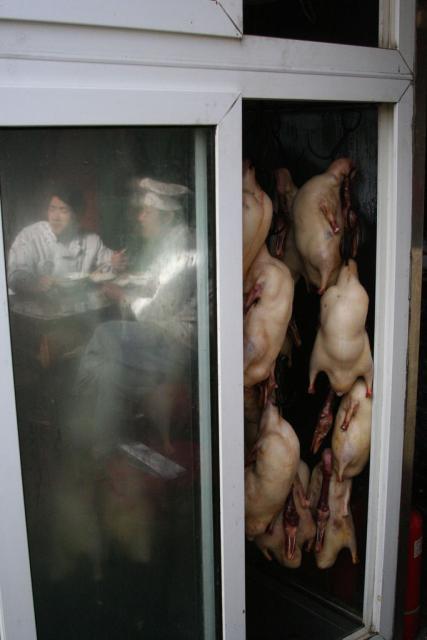
Li Qun Roast Duck (with reflection)
The one item I’ve seen at Chinese restaurants in the States that I was confident I would find in Beijing is roast duck (or, as we call it back home, “Beijing Duck” or “Peking Duck”). You can find Peking Duck at many Chinese restaurants in the US. Unless you go to restaurants that specialize in Peking Duck (like the wonderful Peking Duck House in New York City’s Chinatown where I recently took my mom, who has become quite an adventurous eater in recent years), you may have to order your duck a day or two in advance.
Li Qun Roast Duck
After a little research, we discovered two restaurants that were reported to excel in roast duck in Beijing – Dadong Roast Duck Restaurant and Li Qun Roast Duck Restaurant.  The former, Dadong, is an upscale joint that caters to wealthy Chinese and tourists. The white tablecloth restaurant is huge and gorgeous.  There must be a staff of a hundred catering to your every need. Once your duck arrives, a chef dressed in white meticulously carves the roasted goodness right in front of you.
Roast Duck and pancakes at Dadong
The second restaurant, Li Qun, has a completely different environment.  Hidden in the hutong (the old, historic neighborhoods) south of Tiananmen Square, Li Qun has a very rustic feel.  There are only a handful of tables and you must call in advance in order to ensure a duck has begun the roasting process.  A diner looking for immaculate conditions in their dining experience would be better off heading to Dadong.

The process of eating duck is the same at each restaurant. The duck, including the duck skin, is sliced in front of you. You might think – duck skin? Isn’t that disgusting? Actually, the crispy duck skin is easily the best part. Keep in mind that I also think fried pork skins are a culinary delight (which have been so slandered by high-browed diners that I prefer to eat them in solitude for fear of judgment).
Duck side dishes at Dadong
The sliced duck is accompanied by, at a minimum, three items – “pancakes”, sliced scallions and hoisin sauce (a delicious plum sauce).  The pancakes are thin, translucent and round; they have very little taste as they are primarily used as a vehicle for consuming the duck.  Similar to making a fajita, you stuff the pancake with duck, scallions and hoisin sauce. In some cases, additional items are available including sliced cucumbers, garlic paste and sugar (a crucial item, in our opinion). The stuffed duck pancake is nothing but fantastic.

After comparing the two restaurants, we couldn’t choose a favorite. While we liked the upscale atmosphere at Dadong, we also appreciated the old-school charm of Li Qun. The duck was exceptional at both. [embedplusvideo height=”350″ width=”450″ editlink=”http://bit.ly/1tatGZ2″ standard=”http://www.youtube.com/v/eDZ8FJUCxKM?fs=1″ vars=”ytid=eDZ8FJUCxKM&width=450&height=350&start=&stop=&rs=w&hd=0&autoplay=0&react=1&chapters=&notes=” id=”ep3994″ /]

being_street_4
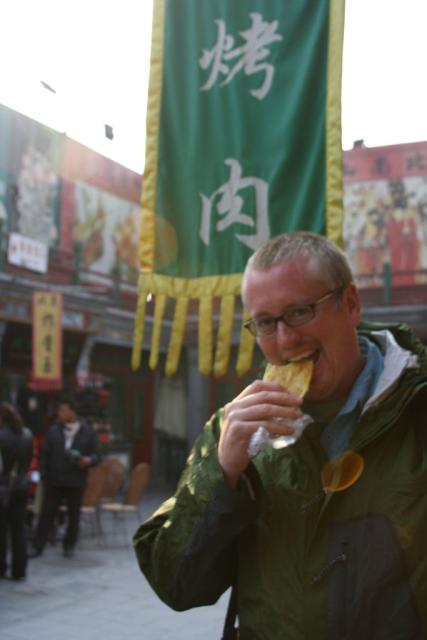
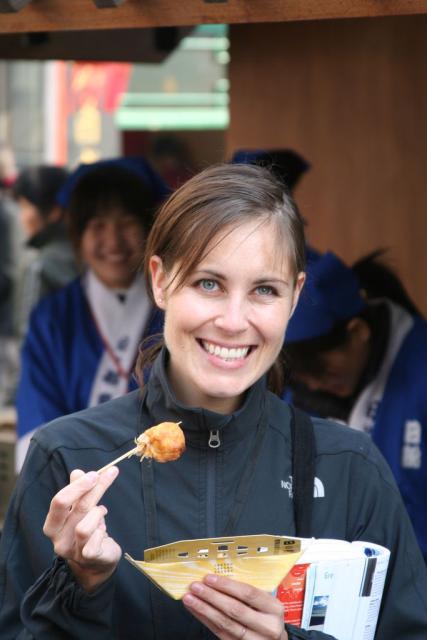
In virtually every guidebook you’ll read about China and other developing countries, there is a section describing the dos and don’ts (well, mostly the don’ts) of eating.   Cardinal sin number one in many books is eating the street food – that is, food sold by vendors that you can find on virtually every street in Beijing.  If you haven’t already guessed it, I don’t follow their advice.
being_street_1
Street food is the essence of a city’s cuisine.  If you ask New Yorkers what their favorite dining memories are in NYC, a surprising number will tell you about a hot dog vendor on the Upper East Side or a gyro stand in Midtown.  I’m sure there are ongoing debates among the Hispanic immigrants in Nashville as to which taco truck on Nolenseville Road dishes out the best tacos (in my non-Hispanic opinion, the taco truck parked in a parking lot on the right side of Nolenseville Road just north of 1-440 is the best).    
being_street_2
A substantial number of a city’s residents rely on these vendors to fill their belly on their way to work in the morning, to provide a much-needed snack during the afternoon or to provide a quick and cheap dinner after a hard day’s work.  If you love food, avoiding street food in a city is akin to an artist visiting Paris and skipping the Louvre. 

There are, of course, a few guidelines to follow.  You can’t just dive into the first beef skewer that’s being cooked on a makeshift grill on a side street because the downside of bad street food (especially in Asia, where the “facilities” are not quite 5-star in most places) can be so bad as to require professional counseling upon your return home.
being_street_3
Without further adieu, I present to you the Hughey Street Food Guidelines:

  1. Follow the Crowds.  If the locals are lining up to sample the offerings, you should be fine.  Not only do you have the natives’ seal of approval that the food is not poisonous and is probably delicious, you have better assurance that the food hasn’t been sitting around for hours (or days…).
  2. Is it Clean?  If the vendor takes pride in keeping his stall or cart clean, there is a better chance that he cares about the safety of the food.  Many people have an assumption that the kitchen at a restaurant is always better than street food, but you usually can’t see the kitchen at a restaurant.  For all you know, there is a local colony of rats residing behind the kitchen door.  With street food, it’s all out in the open.
  3. Do Your Research.  Try to find out the local delicacies of a city before you get there.  Not only will you get to sample the best the region has to offer, you’re more likely to get sanitary food because you’re eating what the locals eat (and not something the street vendor has cooked for an unknowing tourist).
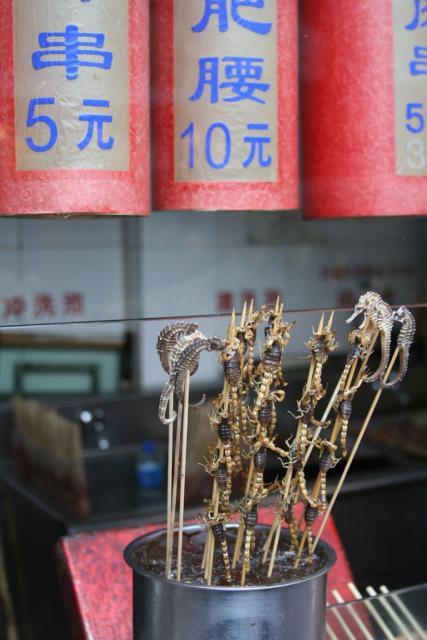
  4. Know Your Limits.  Not everyone’s stomach has superpower bacteria-fighting abilities.  Even though Johnny is calling you a sissy while he downs a grilled seahorse (as we saw in Beijing the other day), you may want to stick to the fried noodles with vegetables.
  5. Small Doses.  The beauty of eating street food is that you can sample lots of different items because, in many cases, the street vendors huddle in groups.  If you pig out on one item, you may not leave room for that delicious fried caterpillar right down the street.
  6. Relax.  If you’ve traveled across the globe to visit an exotic land, don’t dampen the experience by always playing it safe by eating in the tourist restaurants or the local McDonald’s.  You’ll miss out on some great food and even better stories.

a_great_3
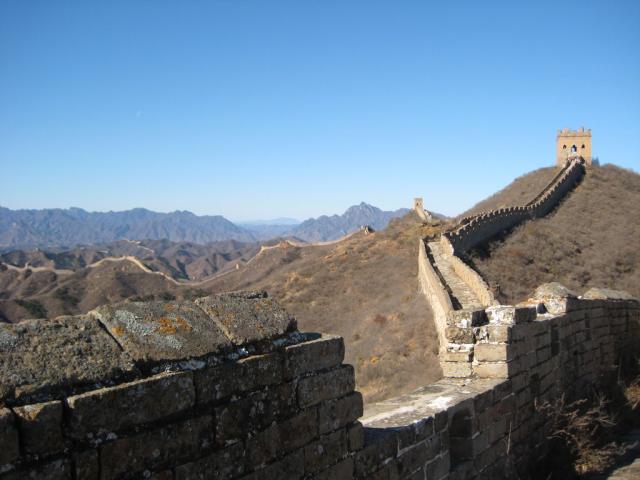
According to Mao Zedong, “he who has not climbed the Great Wall is not a true man.”  I’m not sure what this means for me, but Derek, at least, now qualifies.  We hiked a relatively rugged 10 km of the Wall yesterday, from a small town called Jinshanling to another one named Simatai.  I didn’t know what to expect before we arrived: Would it be overrun with tourists? Even more beautiful than we’d seen in pictures? Once we finally stepped onto its rocky surface, I was overcome by its majesty.  The structure alone is amazing, but its true beauty emerged for us when we saw it in the context of the barren, rolling hills that surrounded it.
a_great_2
Construction of the Great Wall began over 2000 years ago, when emperor Qin Shi Huang organized (some would say conscripted) hundreds of thousands of workers to connect a series of separate walls that had been built by independent kingdoms.  While the Wall never really functioned as the impenetrable line of defense against northern invaders that it was intended to be, it ultimately worked very well as an elevated highway.  Legend has it that one of the building materials used in the Wall was the bones of deceased workers, earning it the gruesome nickname “the longest cemetery in the world.”  Oh, and you can’t actually see it from the moon (although astronauts have reported seeing it, as well as highways and railroads, from a low orbit of earth).
a_great_1
The section of the Wall that we visited was fairly steep in parts, so it made for a great hike.  Although we encountered some other tourists and a handful of vendors (thanks, but no, we don’t want to buy shirts that say “I climbed the Great Wall…”), we were still able to explore the Wall and its watchtowers, where soldiers used to burn wolf dung to signal enemy movements, in relative privacy.  Truly a once-in-a-lifetime experience…which is not to say that we won’t come back as soon as possible!

[embedplusvideo height=”350″ width=”450″ editlink=”http://bit.ly/1tatUiR” standard=”http://www.youtube.com/v/KxZeDhakBQ8?fs=1″ vars=”ytid=KxZeDhakBQ8&width=450&height=350&start=&stop=&rs=w&hd=0&autoplay=0&react=1&chapters=&notes=” id=”ep2342″ /]

under_blood1
Standing in the middle of Tiananmen Square a few days ago, I looked up at a monstrously huge portrait of Mao and finally began to understand that, although Beijing often feels a lot like New York, China and the US, in some ways, are still a world a part.  The sharp elbow to my ribs delivered by the elderly Chinese woman next to me only reinforced this point.   I don’t know if it’s simply tradition or if it’s a custom born of being in a country with so many other people (1.3 billion!), but Chinese people seem to have a very different concept of personal space than what I’m used to…i.e., they don’t seem to really believe in it.  My tiny assailant was trying to get by me in order to have a better view of the military guards who were lowering the Chinese flag in the square, as they do at every sundown.  I stood my ground, in part because we onlookers were packed so tightly together that I had nowhere to move, and she adapted by reaching around me and snapping  few pictures.  The ceremony itself was well worth the jostling, if only for the opportunity to photograph the Chinese military in action.
under_blood4
The next day, we walked under Mao’s glaring countenance, through the Gate of Heavenly Peace and into the Forbidden City.  Looking around the clusters of ancient buildings, which once housed two dynasties of emperors and was off-limits to the public for some 500 years (hence its name), it all felt a little surreal.  Although we soon discovered that the largest and most important structure, the Hall of Supreme Harmony, was completely obscured by a web of scaffolding–sad!–nearly everything else was on full display.  Despite the cold (Beijing in late fall feels a lot like Michigan: crisp and chilly), we spent a happy few hours wandering the complex and learning as much as we could from our audio guides.  (Hey, no one ever said we were cool…)
under_blood3
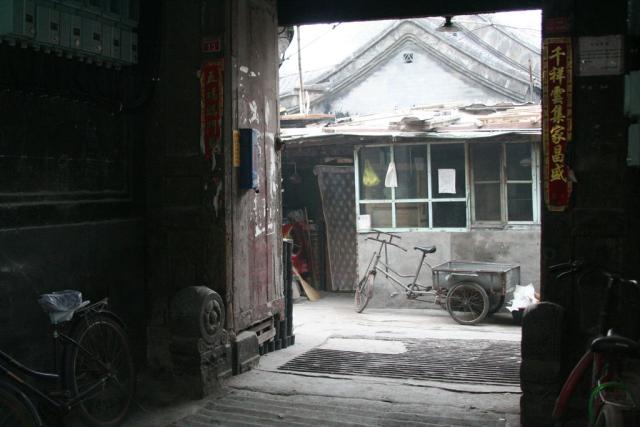
Later, after some fierce bargaining over the fare, we boarded a trishaw and journeyed into the narrow alleyways of Beijing’s hutong.  Hutong are warren-like clusters of ramshackle, one-storey houses that are scattered throughout the city.  Although 1/4 of Beijing’s residents currently live in them, a lot of hutong are facing demolition as part of the city’s pre-Olympic gentrification.  They’re run-down, but full of character; we quickly fell in love with them.  (In fact, as I write this, I’m tucked into a corner of a cozy coffee shop in our favorite hutong.)  I think pictures probably explain their beauty a lot better than my words can…
under_blood2
A dearth of train tickets means that we’ll be in Beijing for a bit longer than we’d planned.  Frankly, I couldn’t be happier.  We could be here for months and still not take it all in.

[embedplusvideo height=”350″ width=”450″ editlink=”http://bit.ly/1tauhds” standard=”http://www.youtube.com/v/5IXCO41GpKw?fs=1″ vars=”ytid=5IXCO41GpKw&width=450&height=350&start=&stop=&rs=w&hd=0&autoplay=0&react=1&chapters=&notes=” id=”ep6862″ /]

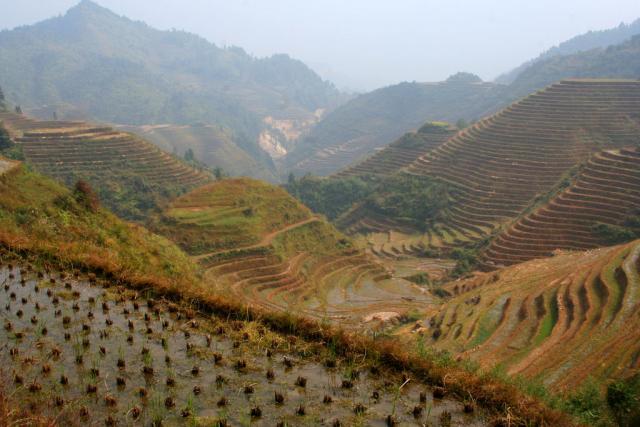
We’ve just emerged from a 600 year-old village in Southern China, where we climbed countless hills and took a truly embarrassing number of pictures (over 400 in one day!; here’s a link to some of the best).  Called Ping’an, the small-but-ever-expanding locale where we happily passed two days is situated on the main ridge of an engineering feat known as the Dragon’s Backbone Rice Terraces.  Farmers apparently started constructing these terraces, which wrap around the steep Chinese hillside like never-ending ribbons, as early as 1271.  Over 700 years later, they’re just now starting to show up on tourists’ must-see lists.

marching2
Ping’an itself is an idyllic little place where wooden buildings hug the hillsides and horses and cows wander the narrow, stone alleyways with basket-toting locals in tow.  It’s expanding now to accommodate the vast number of tourists who will soon swell its population.  Indeed, the whole town smells like the freshly cut wood that’s being used to construct the hotels and restaurants that are springing up everywhere.  An army of Yao women in fluorescent pink native dress greets travelers as they arrive, hoping to coax them into purchasing some local handicrafts.  (Yaos are a Chinese minority whose women are famous for their incredibly long hair, which reaches nearly to their knees.  Signs everywhere proclaim that Guinness has recognized the area as the “long-hair village.” Research didn’t substantiate that claim in its entirety, but it did prove that record for the world’s longest hair belongs to a woman who lives in the area.  But I digress….)
marching3
While we didn’t take advantage of any of the bargains that the Yao women claimed they were offering us, we did enlist Leun, a pint-sized Yao women, to be our guide for a day.  She had to have been at least 70 years old, and she couldn’t have weighed more than 85 pounds, but she had no problem leading us on a hilly, five-hour hike to Dazhai, a nearby town that our guidebook assured us would allow us to escape even the few tourists staying in Ping’an during this, the beginning of the low season.
marching1
With Leun in the lead, we climbed up and down the countless terraces between Ping’An and Dazhai.  It seemed that each was more beautiful and other-worldy than the one that came before it.  Cows lazily watched from the sidelines as we stopped every few minutes to take pictures.  A group of Yao women tracked us down on the trail and, for a small fee, took down their long hair so we could marvel, first-hand, at its incredible length.  We encountered far more farmers than tourists, and we finished the hike pleasantly tired and ready to devour some dumplings and sleep soundly in our $8-a-night hotel (which, itself, smelled of freshly-cut wood).

Ping’an is one of the handful of places we’ve seen so far that we feel compelled to recommend to everyone we know before it changes beyond recognition.  Hopefully, the pictures alone will be enough to convince you to make the trip!

[embedplusvideo height=”350″ width=”450″ editlink=”http://bit.ly/1tautcH” standard=”http://www.youtube.com/v/-gqhloinpIA?fs=1″ vars=”ytid=-gqhloinpIA&width=450&height=350&start=&stop=&rs=w&hd=0&autoplay=0&react=1&chapters=&notes=” id=”ep7492″ /]

Yangshuo Countryside
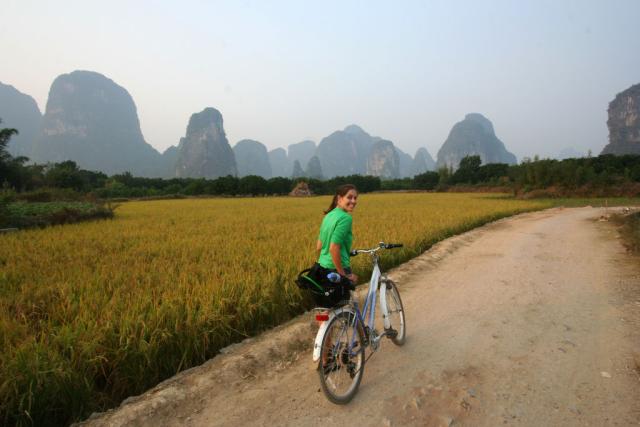
Wanting to see the karsts in their natural surroundings (i.e., not in the middle of a bustling city), we made our way to Yangshuo, an hour south of Guilin.  Our first order of business was to rent bikes and hire a guide who could show us the way off the beaten path.  We wound through the spectacular countryside, following dirt roads through rice paddies and small villages.  We climbed Moon Hill, one of the karsts in the area that has a hole near the top that is said to resemble various stages of the moon, depending on one’s vantage point.  We sailed down the Yulong River on a bamboo raft.
Yangshuo countryside
Yangshuo is a photographer’s dream.  Everywhere we looked, another National Geographic-worthy shot appeared.  We must have taken 300 pictures during the course of the day, and I’m pretty sure our guide developed a strong hatred for us and our cameras.  Here’s a link to some of our best shots.
Villager from Shitoucheng New Village
Prior to our arrival in Yangshuo, we read about a nearby village, Shitoucheng, that was only for “adventurous, independent travellers.”  Clearly, we had to prove our worthiness as backpackers by checking it out.  After a series of trips on local buses (which we navigated mainly by miming, as we’re desperately unable to retain all but the most basic Chinese words), we commandeered two local men on motorcycles to carry us up the karst peaks to Shitoucheng’s new village.  One of the men stayed on to lead us to the old village and the ancient walls that we had come to see.  An hour’s worth of steep, rocky stairs later, we were hiking between the walls (whose history seems relatively unknown) and through fields of rice and chili peppers.  We took a look around a family home, which had no modern amenities in sight, and then wound our way back down to the new town, whose satellite dishes (even though attached to wooden shacks) seemed futuristic in comparison.

Later, we joined thousands of Chinese tourists for Impressions Liu Sanjie, a light show that featured 600 locals–many of them fishermen–performing on (yes, on!) the Li River amongst 12 majestic karsts.  The show was directed by movie maker Zhang Yimou, who is also in charge of the opening ceremonies of the 2008 Beijing Olympics.  If what we saw was any indication, everyone watching the Olympics will be in for a treat.

[embedplusvideo height=”350″ width=”450″ editlink=”http://bit.ly/1tauKMJ” standard=”http://www.youtube.com/v/f1GzXelUT5E?fs=1″ vars=”ytid=f1GzXelUT5E&width=450&height=350&start=&stop=&rs=w&hd=0&autoplay=0&react=1&chapters=&notes=” id=”ep7785″ /]

[embedplusvideo height=”350″ width=”450″ editlink=”http://bit.ly/1tauOvW” standard=”http://www.youtube.com/v/KFx5YUSwkvM?fs=1″ vars=”ytid=KFx5YUSwkvM&width=450&height=350&start=&stop=&rs=w&hd=0&autoplay=0&react=1&chapters=&notes=” id=”ep6034″ /]

After having dim sum with Wensi (our new friend in Guangzhou) and her husband, Andy, and daughter, Sunny, we took a short flight to Guilin.  For centuries, poets and painters have celebrated the beauty of Guilin’s natural surroundings.  A famous inscription in the town explains that its scenery “excels all in China.”  As we drove from the airport, we soon noticed giant, cylindrical mountain peaks jutting up from the ground.  These limestone “karsts” were thrust up from the sea many,many years ago and carved to their present-day configurations by centuries of erosion.
beware_the_3
We had read several reports about the harm that had come to Guilin as it became famous.  We soon found these reports to be correct.  Thousands of tourists have flocked here in recent years to view the scenery.  With their new-found wealth, the Chinese are touring their country in droves.  Tour buses are everywhere in Guilin, and we constantly feared being trampled by a stampede of Chinese tourists wearing matching hats or shirts and following their flag-holding guide.
beware_the_2
Notwithstanding the mass tourism, there are a few sites worth visiting in Guilin.  After renting a couple of bikes and slurping down a noodle soup breakfast in a local dive, we rode to Seven Star Park.  The park was opened as a tourist destination around 600 AD!!!  That’s right, tourists were flocking here over a thousand years before America was even founded (sort of puts things in perspective…).
beware_the
The park consists of seven peaks and includes several caves, including the gorgeous Seven Star Cave, which we had all to ourselves after we convinced the guard at the entrance to let us enter even though it was temporarily closed.  We also walked open a small zoo housing two giant pandas.  Despite some alarming heckling by a few of the visitors, the pandas were content to doze away the afternoon.
beware_the_4
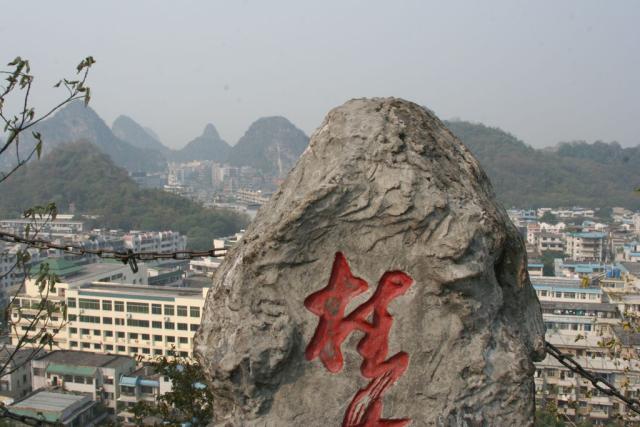
We also visited Solitary Beauty Peak, a karst in the center of town that, after requiring you to climb several hundred stairs, rewards you with a great view of the city.  All in all, Guilin offers tourists a great way to spend a couple of days.  If only so many of them didn’t take it up on its offer…

[embedplusvideo height=”350″ width=”450″ editlink=”http://bit.ly/1tauYTU” standard=”http://www.youtube.com/v/c1ph8FpQ0aM?fs=1″ vars=”ytid=c1ph8FpQ0aM&width=450&height=350&start=&stop=&rs=w&hd=0&autoplay=0&react=1&chapters=&notes=” id=”ep6204″ /]

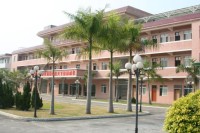
If Derek and I weren’t going to be on the road for the next eleven months, I’d say there’s a fair chance that, sometime during the last four days, we would have adopted a Chinese daughter.  We’ve just returned to Guangzhou from the Social Welfare Institute of Yangxi, an orphanage in the southeastern part of China.  I’m not sure that we’ve digested everything that happened during our time there, but perhaps we never will.

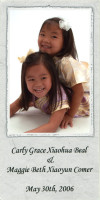
We found the Institute through Mindy Sontag, a dear friend in Nashville whose niece Maggie was adopted from there four years ago.  When Mindy learned that we wanted to do some volunteer work during our time in China, she asked if we would be interested in stopping by.  We responded in the affirmative, and she and her family, along with Derek’s parents and the parents of another little girl – Carly – who was adopted from the same place, offered up a very generous amount of money for us to use to purchase whatever the orphanage needed.  (We’ve posted a picture of Maggie and Carly below).
in_honor_of_2
We arrived in Yangxi on Wednesday with pockets full of Chinese yuan.  We literally showed up on the orphanage doorstep and–with much gesturing and thumbing through our very cursory Chinese phrasebook–announced “we’ve come bearing gifts…let’s go shopping.”  And so we piled into a minivan with a bunch of the Institute’s higher-ups.  In a prelude to the incredible hospitality that the staff would show us over the next few days, our first stop was a hotel, where the orphanage director negotiated a rate for us that was 1/5 of the one posted.   Then we were off to the market, where the staff selected a bouncy chair, a blender, 200 baby bottles and some plastic baskets.  Our next stop was an appliance store, where a washing machine and a bottle sterilizer were purchased in rapid measure.  Later, the director placed an order for 90 onesies (for those of you without kids, that’s a kind of baby clothing…), which should arrive next week.  We found ourselves wishing that Mindy and family were there to witness the shopping spree.

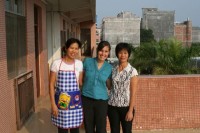
Having obtained permission to volunteer  atthe orphanage for a couple of days, we arrived on Thursday morning and spent a couple of hours folding what must have been thousands of cloth diapers.  And then we got to meet the babies.  Here’s the part we haven’t digested yet.
in_honor_of
In our estimation, the Institute houses about 60 babies, 58 of whom are girls.  (The remaining two are boys who appeared to be mentally and physically challenged.)  This incredible gender disparity is a product of China’s one-child policy.  Adopted in 1979 with the goal of limiting population growth, this policy restricts all urban Chinese families to one child apiece.  Rural families are allotted two children, and the eight percent of the population who qualify as minorities are exempt from the policy altogether.  Traditional thought values boys over girls, and so families with a limited number of opportunities to try for a boy sometimes abandon newborn girls.  For obvious reasons, I really struggled with this.

Because I’m entirely unfamiliar with orphanages in general and Chinese methods of child-rearing in particular, I’m finding it very difficult to write an objective report of the babies’ living conditions.  It seems that their basic needs are being met.  The appear to be well-fed.  Their diapers and their clothes are changed on a regular basis.  The institute is clean.  I’m not sure how much more one could legitimately expect.

in_honor_of_3
With that said, the babies spent the great bulk of their time in small cribs made of metal bars and rough, wooden planks.  (Yes, they sleep on wood.)  They often have only a towel for a blanket.  We saw a lot of open sores and runny noses.  We saw no mobiles, no stuffed animals, no books.  We saw neither soap nor baby wipes.  My heart ached every time I entered the rooms where the babies lived, and I found myself wanting to hold each one long enough to instill in her the memory of being touched.  It was not easy, and we left with heavy hearts.  We also left on a mission to purchases a mattress for each crib.
in_honor_of_4
Wensi, a kind woman here in Guangzhou who works at this area’s umbrella adoption agency and speaks fluent English (hooray!) gave up her Saturday today to help us with this task.  All day today, our Chinese guardian angel helped us to navigate this city’s busy streets and its many baby supply stores.  She also helped us to understand a lot of what we’d seen at the orphanage.  For instance, she explained that many Chinese babies sleep on wooden boards because their parents believe that it promotes bone growth.  She also assured us that all of the orphanage’s healthy babies eventually get adopted (not so for the not-so-healthy ones; they often remain institutionalized).  Her agency processed 2,200 adoptions last year alone.  Wensi told us that most Chinese people endorse the one-child policy as a way to prevent food shortages and other pitfalls of over-population.  We left her with a better understanding of how the American lens through which we view the world perhaps made a difficult situation appear even more dire than it actually was.  The perspective she offered was invaluable.

We’re meeting Wensi and her daughter in the morning to discuss over a dim sum brunch the mechanics of procuring crib mattresses (not American-style thick, but with a Chinese-acceptable level of padding) from a nearby factory.  We can only hope that, someday, she’ll visit us in the US so that we can try to repay the incredible kindness that she’s shown us.

Around the world, there are many different styles of eating.  Due to our famed individualism, Americans are accustomed to ordering our own meal at a restaurant and rarely sharing with anyone else at the table, unless that person is our significant other (in which case we will sometimes share, but begrudgingly).  This style of eating is virtually unheard of in the East.  In Asian restaurants, a variety of dishes will be ordered (in many cases, the ordering is done by one person – sometimes with input from others) and the items will be brought out and placed in the middle of the table to be shared by all (for Southerners reading this, think “family-style”; for Nashvillians reading this, think “Monell’s).  To me, there is no better way to eat.  By ordering multiple dishes, you get to try lots of different flavors without envying the entree ordered by a fellow diner.
Dim Sum at Maxim's
One of my favorite types of “family-style” ordering is “dim sum.”  I first sampled dim sum when I was in Hong Kong in 1996 and, since then, I’ve sought it out in various places (especially at the Golden Unicorn in New York’s Chinatown).  For those who’ve never experienced dim sum, it is a style of eating famed in Hong Kong and the Canton area of China which takes place mostly on weekends during “brunch” time.  While Americans have their omelettes, eggs benedict and french toast, the Chinese sample steamed dumplings, “shumai”, pork buns, chicken feet! and hundreds of other small dishes.
Dim Sum at Maxim's
In many places, the various items on offer at a dim sum restaurant are wheeled around on a small cart.  As the cart goes by, the names of the dishes are yelled out by the cart-pusher (or if your Chinese is lacking, or in my case nonexistant, the cart-pusher will take the cover off the dishes to show you what’s underneath).  If you like what they have, you point to the item and it is placed on your table.  The cart-pusher marks a card on your table with what you ordered and heads off to the next table.  The food, which is served as small dishes (sort of like Spanish tapas), is generally amazing.  I’m especially fond of the shumai and the pork buns.

[embedplusvideo height=”350″ width=”450″ editlink=”http://bit.ly/1tavcuq” standard=”http://www.youtube.com/v/IMUFXnRxcWA?fs=1″ vars=”ytid=IMUFXnRxcWA&width=450&height=350&start=&stop=&rs=w&hd=0&autoplay=0&react=1&chapters=&notes=” id=”ep9722″ /]

While in Hong Kong, we sought out Maxim’s City Hall Palace – a restaurant that’s supposed to serve some of the best dim sum in the world (and, based on some awards on the wall, the best in Hong Kong).  The restaurant was packed, requiring a wait of about an hour.  Once we were seated, however, the foodcarts immediately made it our way where we ordered quite aggresively.  I was getting embarrassed with how much we had ordered until I looked around and saw that all the other Chinese diners where ordering even more than we were.  After finishing off several pots of jasmine tea and eating more dumplings than I care to admit, we left the restaurant and decided to take a long walk in downtown Hong Kong to help burn off the amazing feast.

« Previous PageNext Page »