oh_chi_1
When I first visited Ho Chi Minh City (formerly known as Saigon) with my parents back in 1996, I was mesmerized.  Decades of French rule ending in the mid 1950s and a massive presence of American military during the 60s and early 70s have combined to create a city steeped in history.  In 1996, the streets were jammed with thousands of people heading to various destinations via bicycle, with the occasional motorcycle ridden by the Vietnamese elite.  The only signs of Western influence were the few French-era buildings and hotels that were mostly in need of renovations and a paint-job.
ohchi3
Wow, how things have changed!  In the past 12 years, the economy of Vietnam has skyrocketed.  With investments flowing in from around the world (including the United States), the Vietnamese have been able to increase their standards of living exponentially.  Bicycles have been replaced by countless motorcycles, and the Vietnamese elite now drive European sedans.  On almost every corner, there is a French bistro, sushi restaurant, boutique hotel or jazz club.  The city is virtually unrecognizable from a little over a decade ago.
ohchi4
Our time in Ho Chi Minh City coincided with the climax of Tet, the Vietnamese New Year (for all of you rat-lovers, you’ll be happy to know that this year is the Year of the Rat).  Our guidebooks had warned us that the city shuts down during the holiday as families spend time together in their homes; the streets would be deserted.  Lies!  The roads (and sidewalks…) were filled with motorcycles, typically carrying 3 or 4 passengers ((After witnessing 4 passengers on one bike, we were intent on finding a bike carrying 5.  Luckily, a 5-passenger bike was spotted soon after our search began, followed by a 6-passenger bike a few days later.  I’m not sure the good people at Honda knew that a family of 6 would utilize its scooter for a family outing.)), and Vietnamese families packed the streets much like New Yorkers pack Times Square on New Year’s Eve.  At many times, it was difficult to even move.  You could feel the excitement of a people who know their country is in good times and only headed for better.
oh_chi2
The city is renown for its many pagodas, or temples.  Little did we know that it is a tradition to visit the pagodas during Tet.  As we arrived at a nearby pagoda, we were overwhelmed with the throngs of Vietnamese who had come to show respect to their ancestors.  Inside the pagoda, there are small plaques with the name and picture (and, in some cases, an urn carrying the ashes) of a deceased relative.  The visitor waves a few sticks of incense in front of the plaque, bows and, in some cases, leaves an offering of an item that the ancestor enjoyed (e.g., fruit, cookies or even beer).

The remainder of our time in the city was spent at the other main sites including the Presidential Palace, where the President of South Vietnam resided prior to the end of the Vietnam War, and the War Remnants Museum, a museum displaying some fairly brutal and grotesque pictures from the Vietnam War, with captions that were only a bit more objective than the ones we had seen at the DMZ.

Given its vibrant culture, its energy and the many opportunities it offers to experience history firsthand, I can’t help but think that we’re going to Miss…Saigon (pun most definitely intended).

[embedplusvideo height=”350″ width=”450″ editlink=”http://bit.ly/1sVcqGg” standard=”http://www.youtube.com/v/iveOfkIzOkM?fs=1″ vars=”ytid=iveOfkIzOkM&width=450&height=350&start=&stop=&rs=w&hd=0&autoplay=0&react=1&chapters=&notes=” id=”ep4733″ /]

good_morning2
Our visit to Vietnam would not have been complete without a trip to the demilitarized zone, or DMZ.  This strip of land, which is approximately two miles wide, divided North and South Vietnam before and during the Vietnam War (or, as it’s called here, “the American War” or, depending on the speaker, “the War of American Imperialism” or similar). It thus separated Ho Chi Minh’s Viet Cong (VC) in the north from the American and South Vietnamese forces down south.

Nearly every American of our generation has friends and loved ones whose lives the war changed forever.  Our uncles and our fathers served there (as did a few thousand women), and we’ve seen its lasting impact on them.  We’ve grown up watching movies about the battles waged from 1963 to 1973 and hearing stories about the discord the war prompted back at home.  While Derek, Alyssa and I knew the basic outline of what took place during those troubled years, there was nothing like a field trip to the actual war zone to make it all hit home.

At 6:00 a.m. one morning, we boarded a bus full of tourists (some American, some non-) and set off for the DMZ, not really knowing what to expect.  At the end of the day, we had not only seen the sights, we had learned an important lesson about how cultural perceptions can influence the retelling of history.
good_morning1
Our pint-sized guide (he maybe came up to Derek’s elbow) had a father who fought for the North and uncles who enlisted for the South. Like his American counterparts, he had grown up in the shadow of the war, only–given his geographic location—much more so.  Born and raised in post-war Vietnam, he saw on a daily basis the physical destruction that the war caused, and he told us that his father died from the effects of Agent Orange.  Needless to say, playing witness to the war’s devastation left him less than impartial: many of the facts he recited to us contrasted sharply with those in our Australian-written guidebook, and he peppered his spiel with adjectives that made the Americans on board bristle a bit.

For me, one of the most interesting parts of the tour was the time we spent at the Khe Sanh Combat Base.  Americans of our parents’ generation will remember Khe Sanh as the marine stronghold that President Johnson, in 1968, feared would soon be the site of a massive Viet Cong siege.  The media took up the cry; Newsweek and Life both did cover stories on the impending attack.  Huge supplies of planes, troops and ammunition were amassed to ward off the threat from the North, but it never really materialized as planned (the siege was much smaller than expected).  Many scholars now believe that the VC threatened to attack Khe Sanh in order to distract US forces while the VC readied itself to launch the now-famous Tet Offensive. As it turned out, the comprehensive attacks that the North launched during the Tet holiday that year severely wounded the US and its allies and, according to many, mobilized American public opinion against the war.
good_morning_3
Khe Sanh now plays home to a small museum that prominently features pictures of Vietnamese soldiers doing various activities that, according to the captions, “Caused the Americans to flee in panic.”  The comments in the museum’s guestbook were at once intriguing and heartbreaking.  In addition to the usual “Peace Now” and “Down with the American Imperialists” messages were words from widows of American soldiers, from a mother whose son had been killed at Khe Sanh and from a U.S. Brigadier General named Tommy Bell: “I fly 243 missions here during 1966-1967.  We may have killed two million Vietnamese.  For this I am very sorry.  I will never fight another war.”  Those comments will stay with me far longer than anything I might have read in a history book.
good_morning4
After brief stops at the Rockpile and Dakrong Bridge, our bus pulled up to the Vinh Moc tunnels–almost 2 miles of underground passageways in which North Vietnamese women and children lived during the war, largely protected from the bombs that rained above their heads.  Not a place for claustrophobics, the dark tunnels are about five and one-half feet tall and maybe three feet wide.  They form a sort of warren, complete with meeting rooms, living areas and a maternity ward where 17 babies were delivered during the war years, only to spend the first years of their lives entirely underground.

All in all, our day in the DMZ allowed me to glimpse the vast differences between American and Vietnamese perceptions of the war.  Particularly given the debates over our country’s current involvements on foreign soil, it also afforded me a timely and much-needed history lesson. Now it’s time to hit the books in search of answers to the many questions raised by our time in a place where so many soldiers–American and Vietnamese alike–gave their lives in service to their country.

[embedplusvideo height=”350″ width=”450″ editlink=”http://bit.ly/1sVbNN5″ standard=”http://www.youtube.com/v/4kONfahralY?fs=1″ vars=”ytid=4kONfahralY&width=450&height=350&start=&stop=&rs=w&hd=0&autoplay=0&react=1&chapters=&notes=” id=”ep4238″ /]

perfume2
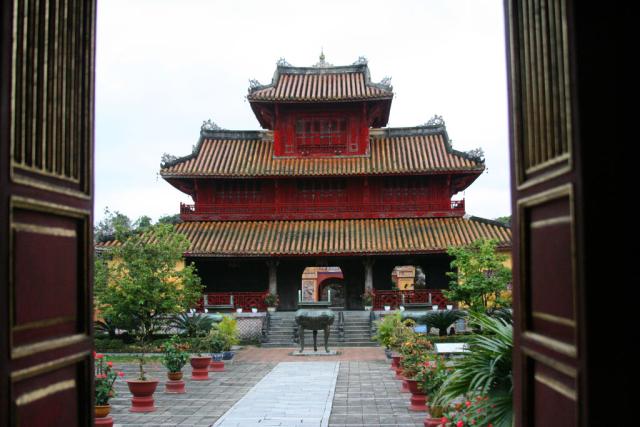
After Hanoi, we flew to Hue, a former imperial city on the banks of the enigmatically named Perfume River.  We spent a mist-filled afternoon exploring the Citadel, a section of the city that is surrounded both by a moat and by tall, thick walls.  These safety precautions did little to defend the area from the Vietnamese-American War; huge swaths of the Citadel were razed during one of the bloodiest battles of the 1968 Tet Offensive.  Tourist dollars are helping to fund ongoing restoration efforts, and the results are already visible throughout the complex.  The Imperial City, a Citadel-within-a-Citadel that once housed the emperor’s residence and important state buildings, looked like a run-down version of Beijing’s Forbidden City but was remarkably free of the hordes of tourists that we’d seen there.
perfume
Hue is known for its food, and we were all eager to (over-)indulge.  We didn’t find too much worth, um, writing home about, but perhaps we were just looking in the wrong places.  We did discover some great snacks at the local market, which buzzed with frenetic shoppers making last-minute purchases for the upcoming Tet celebrations.  Armed with sugary coconut strips and dried, shredded beef (it’s good–seriously…), we left Hue for what, we hope, will be the sunnier skies of Southern Vietnam.

[embedplusvideo height=”350″ width=”450″ editlink=”http://bit.ly/1t0nQbG” standard=”http://www.youtube.com/v/nOi5AsvCgQQ?fs=1″ vars=”ytid=nOi5AsvCgQQ&width=450&height=350&start=&stop=&rs=w&hd=0&autoplay=0&react=1&chapters=&notes=” id=”ep4504″ /]

Google Video

Carrying cumquat trees for Tet
Hanoi is a city difficult not to love.  After finding a hotel in the Old Quarter, we set off exploring its narrow streets.  Historically, each street in the Old Quarter was devoted to selling a certain product, from which it received its name – Flower Street selling flowers, Shoe Street selling shoes and Fish Street selling an array of freshly caught fish.  Around every corner, you are bombarded with sights and smells that are quintessentially Asian.  Outside the Old Quarter, you will find a fairly modern city filled with government buildings (Hanoi is the capitol city of Vietnam), beautifully restored temples and French colonial buildings and gorgeous, tree-lined lakes.
Streets of Hanoi
For us, Hanoi’s vibrance was only enhanced by the upcoming holiday of Tet.  For the Vietnamese, Tet is THE holiday.  Celebrated on the days before and after the start of the Lunar New Year (which falls on February 7th this year), it is when almost everyone returns home to their families.  For a traveler, it is a unique time to be here.  The whole city of Hanoi was filled with vendors selling flowers on every empty sidewalk, markets filled to the brim with shoppers buying food made only during this time of year and streets packed with motorbikes and people trying to make all their last-minute purchases.

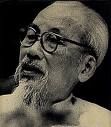
In addition to its many temples and lakes, one of Hanoi’s big draws is the Ho Chi Minh Mausoleum.  Ho Chi Minh is a hero without rivals in Vietnam.  After founding the Community Party in Vietnam, he made it his mission to expel the French colonists from the country.  Ultimately, the French left Vietnam after being defeated by Ho and the gang in 1954 at the battle of Dien Bien Phu, ensuring that Ho would be worshipped as Vietnam’s saviour for generations to come.
Streets of Hanoi
You can’t walk 100 feet in Hanoi (or in virtually every other city in Vietnam) without seeing a statue of Ho or a building or road named after him.  The ultimate memorial is located in a beautiful park in the center of the city where, in a small building, Ho Chi Minh’s body has been embalmed and is open for viewing.  It is an odd memorial to a man who lived a fairly simple life and had specifically requested a basic cremation.

As you are rushed through the small room where his body lies, you are required to dress appropriately, walk quickly, not carry anything with you (especially cameras and phones) and maintain complete silence.  I was especially concerned with this last requirement since silence has never been a virtue of Shanna’s.  Sure enough, within seconds of entering the mausoleum Shanna began talking only to be quickly hushed by one of the many gun-wielding guards.  As I walked past Ho’s body, I was struck by the peaceful nature he exhibited and by his remarkable resemblance to Colonel Sanders.  Perhaps KFC Vietnam has found its mascot?

ringing3

ringing1


[embedplusvideo height=”350″ width=”450″ editlink=”http://bit.ly/1sVdp9s” standard=”http://www.youtube.com/v/wpXGAnEFP6Y?fs=1″ vars=”ytid=wpXGAnEFP6Y&width=450&height=350&start=&stop=&rs=w&hd=0&autoplay=0&react=1&chapters=&notes=” id=”ep3329″ /]

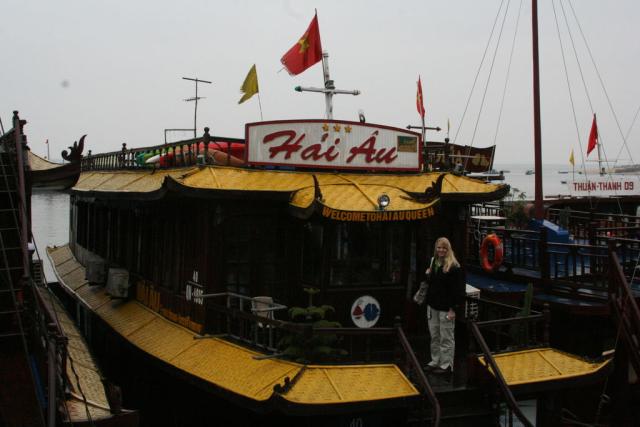
Hai Au Queen Boat in Halong Bay
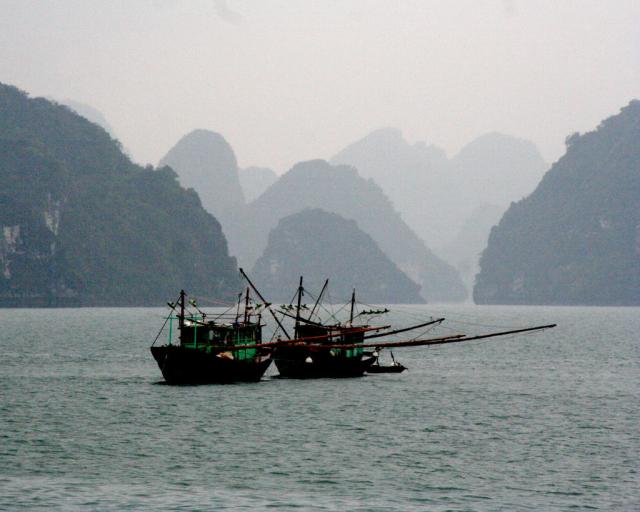
In the green-gray waters of the Gulf of Tonkin sit the more than 3000 limestone karsts that combine to form the wonder that is Halong Bay. The bay has long been a draw for tourists visiting mainland Vietnam; most of us hop on buses in Hanoi and, after a long ride through rice fields and pastel, dollhouse-like homes, step aboard rickety boats (called “junks”) for some time on the open water. That’s exactly what Derek, Alyssa–my best friend who’s traveling with us for a few weeks–and I did a few days ago.  Hurrying through the fine mist that has seemed ever-present during our stay in Vietnam, we boarded the Hai Au and set off to explore the karsts.
Halong Bay
Derek and I had biked through karsts in Yangshuo, China, but seeing them by boat was a different experience entirely.  The tiny, colorful fishing boats anchored in front of the towering karsts create a stunning, almost ethereal landscape, and rumors of a Halong Bay-based Loch Ness monster only increase the intrigue.  (Sadly, if he’s out there, we never spotted him.)

The junk stopped at the three-chambered Hang Sung Sot cave, known to tourists as “Surprising Cave,” likely due to the, err, adult nature of one of the rock formations within.  After exploring the cave, we braved the chilly air and paddled kayaks through a tunnel in one of the karsts and into an idyllic lagoon.  Later, we warmed up over endless games of Uno, which is quickly becoming my favorite travel pastime.  Our captain dropped anchor in the bay for the night, and we all fell asleep to the sound of waves lapping against the boat–not a bad lullaby at all!

[embedplusvideo height=”350″ width=”450″ editlink=”http://bit.ly/1pAD6ge” standard=”http://www.youtube.com/v/eNth54ieVK8?fs=1″ vars=”ytid=eNth54ieVK8&width=450&height=350&start=&stop=&rs=w&hd=0&autoplay=0&react=1&chapters=&notes=” id=”ep3773″ /]

talking_shop
Imagine going into your favorite store and finding that everything fits you perfectly, comes in your favorite color and fabric and is 75% off.  That pretty much sums up our time in Hoi An, Vietnam.  The town was a major port until its river began to dry up; it now finds its commercial edge in the more than 500 tailor shops that line its quaint streets.  I entered one such establishment, Yaly Couture, armed with printouts from the J. Crew website.  Two days later, I shipped home the beginnings of a new, custom-made wardrobe, all purchased at prices dramatically lower than I would’ve paid for the authentic stuff.  Even Derek got into the act and bought a new suit (though, in order to preserve his masculinity and because it’s actually true, I have to admit that he wasn’t quite as excited as I was).
talking_shop2
The town is geared toward the gaggles of tourists who come to shop.  Store after store offers up shoes made to match their new purchases, and excellent restaurants and sidewalk cafes wait to serve those suffering from shopping spree-induced fatigue.  People taking a break from consumerism can spend a pleasant few days wandering the streets of Hoi An’s historic Old Town; they’re lined with art galleries, shoe stores, Chinese lanterns and French colonial buildings and are ridiculously charming.
talking_shop3
Just 15 minutes outside the city are the gorgeous beaches popularized in the late-80’s sitcom, China Beach.  During the Vietnam War (or, as it’s known here, the “American War”), U.S. soldiers stationed all over the country retreated to this long strip of white sand for some R & R.  Today, it’s barely developed, but signs announcing the impending construction of new, luxurious mega-hotels are everywhere.  Like so many other places, this one likely will be nearly unrecognizable in a few years.  Until then, however, Hoi An has something–shopping or otherwise–for everyone, and it all seems to be a great bargain.

[embedplusvideo height=”350″ width=”450″ editlink=”http://bit.ly/1sVdp9s” standard=”http://www.youtube.com/v/wpXGAnEFP6Y?fs=1″ vars=”ytid=wpXGAnEFP6Y&width=450&height=350&start=&stop=&rs=w&hd=0&autoplay=0&react=1&chapters=&notes=” id=”ep7067″ /]

going_down_back3
We’ve covered a lot of ground the last few days, most of it via motorcycle.  From Don Khon, we drove (and, by “drove,” I mean Derek drove and I lazed on the back of the bike) north to the Kingfisher Eco Lodge in Kiet Ngong.  We haven’t been to Africa yet, but I’m pretty sure that the lodge gave us our first taste of what an African safari is going to be like.  From the balcony of our bamboo bungalow, we watched elephants ((Kiet Ngong is one of the few places where elephants are still used to help with farm work.)) munching on impossibly green grass in a field a few hundred feet away.  We climbed aboard one of their peers for a trek up a hill to the archaeological ruins of Phu Asa.  Sadly, we never made it to our destination: our ride took one look uphill, turned around and headed right back home.  I guess that explains why transport via elephant isn’t all that common these days…
going_down_back2
Although we never saw Phu Asa, we did make it to the nearby town of Champasak to see Wat Phu, an ancient Khmer temple complex that’s often compared to Cambodia’s Angkor Wat.  Frangipani-lined walkways led us through the wat’s tumbledown structures, which–even under the glare of the harsh, midday sun–exuded an almost mystical air.

We turned in our motorcycle and boarded a bus bound for Attapeu, a town near the Laos-Vietnam border.  After a night there, we hopped on another bus, this one headed for the Laotian border town of Bo Y.   We had read that it was now possible to cross into Vietnam from Bo Y but, so far, few Westerners have tried it (they usually cross at a place farther to the north).  (I have to admit that I felt both cool and adventurous to be making this attempt, particularly because it’s not yet detailed in the Lonely Planet…)  The bus dropped us off on the Laos side of the sandy border town, which had a decidedly Wild West feel to it, and we walked into Vietnam, where it picked us back up.  Piece of cake.
going_down_back4
Next, it was on to Kon Tum, which boasts a well-deserved reputation as one of the friendliest cities in congenial Vietnam.  We procured both a motorcycle and a guide and set off to explore the area, which was the target of an American bombing raid in 1972.   Our first stop was the Vinh Son orphanage, where I once again fell in love with–and resisted the urge to kidnap–one of the little girls I met.  Although this orphanage was far cheerier and better equipped than the one we visited in China, it was somewhat more depressing, in that many of its wards are never adopted; they live out their entire childhoods in the orphanage.  Of course, this is a much better fate than the one that some of them would have faced had they not been put up for adoption: some of the children are part of an ethnic minority group called the Jarai that, until a recent government clampdown, was known to bury live babies along with their dead mothers.  This horrific practice apparently stems from a time when there were no alternatives to breast milk, and so the death of a mother necessarily meant the demise of her baby.
goin_down_back
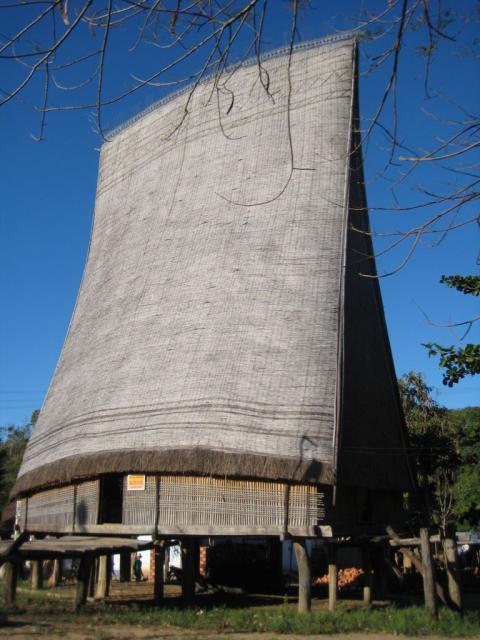
Waving goodbye to the children, we rode to a Bahnar village, where we saw our first rong house.  Kind of like village community centers, rong houses have towering roofs, the height of which is said to indicate the wealth of their villages.  (I wonder if every village strives for a rong house roof higher than the one of its neighbor…)  We left our motorcycle in the village and set off on foot through jungle landscapes and fields where cows grazed under banana trees.   We floated back to the village in dugout boats, one of which was captained by a boy who could not have been more than six years old.  Although we had nearly as many flat tires as we did days on our motorcycle, two-wheeled travel took us to places–and led us to people–that we never would’ve encountered had we rented a car!

[embedplusvideo height=”350″ width=”450″ editlink=”http://bit.ly/1sVaZYv” standard=”http://www.youtube.com/v/79_u2TAZvKs?fs=1″ vars=”ytid=79_u2TAZvKs&width=450&height=350&start=&stop=&rs=w&hd=0&autoplay=0&react=1&chapters=&notes=” id=”ep9509″ /]

who_needs1
After flying out of India and enjoying a couple of rejuvenating days in the cosmopolitan city of Bangkok, Thailand, we boarded a plane to the largest city in Southern Laos – the bustling metropolis of Pakse (population 66,000).  Laos (pronounced like “cow”, but replacing the “c” with an “l”) is a country that has been off the tourist track for…well…ever.  It is quickly starting to attract tourists, but mainly to the Northern part of this small country.  We decided to start in the more remote South, with plans to visit the North a few weeks from now.

As a landlocked country (bordered by China, Thailand, Vietnam and Cambodia), it’s difficult to imagine that Laos’ island life is one of its main attractions.  However, the mighty Mekong River flows through the length of the country, widening at parts to allow islands to form and sustain life.
whoneeds_3
After renting a motorbike for $7 a day, we started down a newly paved road to the island of Don Daeng.  As we were approaching the island, signs for a new lodge in the area began to appear.  Curious, we found a phone, rang the lodge and were on a small boat to the place just a few minutes later.  Riding down the dirt path to the lodge (no cars are allowed on the island, and there are only a smattering of motorbikes), we passed villages that surely haven’t changed much in a hundred years (the island just got connected to the electric grid 2 months ago, so it will be interesting to see how quickly it changes).  A few minutes later, we arrived at La Folie Lodge and discovered a piece of heaven.

The Lodge consisted of 12 bungalows decorated as well as any 5-star resort, a restaurant serving amazing Laotian and French food and a pool that will no doubt make the pages of Conde Nast Traveler magazine in an upcoming issue.  With initial plans to stay just one night, we quickly checked the availability at the lodge and decided to stay three.  Our days were spent lounging by the pool, watching the gorgeous sunset over the Mekong River and riding bikes around the island.  With tourists still a novelty, we were bombarded by village children running out of their huts yelling “Sabadee” (the Laotian word for “hello”) as we pedaled by, their faces lit up by welcoming smiles.
who_needs5
In need of some lunch, we stopped at a hut filled with a group of screaming men huddled around a small ring.  Intrigued, we stood on chairs and looked down in the ring to witness a cockfight in progress.  I quickly scanned the crowd for to see if Michael Vick was there; unfortunately, he was absent.  After briefly watching the bloody battle between the angered, but perplexed, roosters and the even more spirited battle between the onlookers who had gambled on one of the two birds, we somehow still had an appetite.  We ordered a bowl of noodle soup and finished the bowl while conversing in broken English and Lao with a local who seemed more intent on finishing his bottle of rice whiskey than participating in the cockfight spectacle a few feet away.
who_needs4
After leaving Don Daeng, we continued South via motorbike.  About an hour into our ride, we heard an explosion.  We slowly stopped the bike and realized that our back tire had split in two!  As we were starting to wonder how we were going to fix it, our angel appeared…in the form of…a Laotion man riding on a motorcycle…carrying an AK-47.  Angels take all forms, I guess.  As he pulled up next to us, he smiled, pointed down the road and signaled for us to follow him.  Sometimes you just have to follow your instincts, so we set off down the road towards a small hut just a few hundred yards away.  A local mechanic immediately appeared from within the hut, began removing the back wheel from the bike and instructed the militia man to head to town to buy us a new tire.  Twenty minutes and $9 later, the bike was fixed and were on our way.

A couple of hours later, we arrived in Si Phan Don, an area near the Cambodian border that translates as “Four Thousand Islands.”  The islands of Si Phan Don have become a haven for young backpackers attracted to the beauty and ridiculously cheap prices (bungalows right on the river can be found for $1 per night).  Only a few of the islands are inhabited and only one has electricity.  We loaded our motorbike on a ferry and were off to Don Khon, one of the smaller islands that is still off the electric grid.
who_needs2
Similar to Don Daeng, Don Khon consists of a few small villages seemingly lost in time. Besides the laid-back attitude of the island and the picturesque views, the main draw is the local marine life – the endangered Irrawaddy Dolphins are native to this area.  With only approximately 100 remaining, a sighting of this rare breed can be difficult.

After exploring the island by bike the next day, we hired a boat in the late afternoon and set off in search of the dolphins.  We soon arrived at a large rock in the middle of the river.  Approximately 8 seconds after debarking the boat, we spotted our first of many dolphins.  On my visit to Sea World a few years ago, I witnessed some amazing dolphin tricks.  Unfortunately, these dolphins don’t exhibit the Flipper-like skilz of the Orlando-based dolphins.  Instead, they glided lazily through the water, in no hurry to be anywhere or disturb anyone – much like the Laotian people who inhabit this tranquil part of the world.

[embedplusvideo height=”350″ width=”450″ editlink=”http://bit.ly/1t0rX7P” standard=”http://www.youtube.com/v/4cuXEos1bgU?fs=1″ vars=”ytid=4cuXEos1bgU&width=450&height=350&start=&stop=&rs=w&hd=0&autoplay=0&react=1&chapters=&notes=” id=”ep8418″ /]

[embedplusvideo height=”350″ width=”450″ editlink=”http://bit.ly/1AcA2dN” standard=”http://www.youtube.com/v/6UQx84XRAuo?fs=1″ vars=”ytid=6UQx84XRAuo&width=450&height=350&start=&stop=&rs=w&hd=0&autoplay=0&react=1&chapters=&notes=” id=”ep3144″ /]

good_bad_5
I’ve heard travelers say that, when it comes to foreign experiences, there’s India, and then there’s the rest of the world.  No place is this more true than in Delhi.  ((I’ve always been confused about the difference between “Delhi” and “New Delhi.”  From what I’ve read, it seems that “Delhi” encapsulates both “Old Delhi”–the capital of pre-British, Islamic India–and “New Delhi,” which was constructed by the Brits as their imperial capital.))  Our family has an apartment in Delhi, and the promise of both their company and free lodging kept us there for more than two weeks.  In that time–longer by far than we’ve spent in any other place on our itinerary–we got to know at least three of Delhi’s multiple personalities.  Allow me to introduce you to The Good, The Bad and The Wildly Confusing.

The Good:
good_bad_2
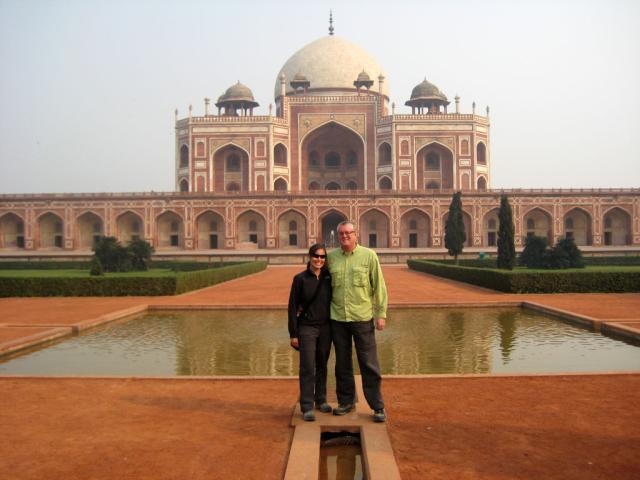
Delhi boasts both an incredible past and a wonderfully vibrant present.  We had a great time touring its many attractions and fell particularly in love with the Red Fort, where a tour guide ((In the past four months, we’ve learned that a good tour guide–generally hired at the location we’re touring and for that location alone; we fear the umbrella-led tour group–can really help us get the most out of the places we’re visiting.  We always talk with the guide first to ensure that he or she speaks great English.  And then we bargain.  Hard.)) made the place come alive for us as he described the luxuries that existed within its thick, sandstone walls during the reign of the Mughal emperor who ruled from there.   We also really enjoyed exploring Humayun’s tomb, an amazing example of Mughal architecture that looks a lot like the Taj Mahal’s little brother.

Another highlight was a visit to the sprawling, 2005-built Akshardam Temple.  The fact that it felt a little like Disney World at times (never before have I seen a food court in a place of worship…) didn’t completely undermine its astonishingly intricate marble and sandstone carvings.  A lot of the temple is still being constructed, so we were able to watch artisans as they created the marvels that, 500 years from now, someone will look at in wonderment and say “how did they make something like that way back then?”.
good_bad_4
The evenings that we spent at an assortment of wedding and new year’s festivities demonstrated to us how incredibly alive and colorful Indian culture is.  Old traditions and new mixed and thrived at these incredible events, where the outstanding food and the vibrating music served as constant reminders that this country really knows how to throw a party.  Watching 20-somethings honor their religion and their family through age-old traditions and seeing grandparents on the dance floor, grooving to a techno remix of Om Shanti Om, I felt proud to be half-Indian.  Sadly, my impressions of Delhi didn’t end there.

The Bad:
good_bad_1
Right down the street from those luxurious parties, people live in slums, burning trash to stay warm as their children turn cartwheels in the crowded streets to try to earn a few rupees from spectators watching from the safety of their cars.  While Delhi’s economy is growing, the gap between the rich and the poor seems terrifyingly wide.  India has the largest population of child laborers in the world (estimated by human rights groups at an astounding 60 million), and this fact is dramatically illustrated throughout Delhi’s streets.

Speaking of streets, the traffic in Delhi is so bad that it’s almost comical.  (We could laugh at the traffic delays because, given our blessedly easy lives at the moment, we rarely had to be anywhere at a certain time.  I can’t imagine the stress that would accompany having to actually arrive someplace at a certain hour.)  We had to allow 45 minutes to an hour to get anywhere by car.  Happily, Delhi has a sparkling new subway system that will hopefully alleviate some of the strain on its roads.

For now, all of those cars, trucks, buses and auto-rickshaws are teaming up to create some wicked air pollution.  I often felt like I was breathing in solid particles (probably because I was…) and, when I ran a white washcloth over my face at the end of the day, the cloth turned gray.  What’s more, Delhi’s streets are littered with trash unlike any I’ve ever seen.  Every corner seems to be growing its own landfill.  The environmental situation is bad and getting worse, which leads me to…

The Wildly Confusing:
good_bad_3
India has environmental laws, but they’re often not enforced.  It has traffic laws (surely?), but the only traffic police I saw in Delhi were the ones helping to control the scene of an accident.  It may even have anti-littering laws but, from the state of things, those would seem to be a waste of the paper on which they’re written.  The lawyer in me mourned for the lack of law and order in Delhi.  (That’s the lowercase “law and order”; I’m can almost guarantee that the TV show is regularly available on cable.) I polled the locals, i.e., my family members, on the cause of this sorry state of affairs.  Many of them pointed the finger at corrupt government officials.  The thinking seems to go like this: why bother following the law when it’s cheaper and easier just to bribe the government official tasked with enforcing it? It pained me.

Less painful but similarly bothersome were the gaggles of ogling young men that seemed to lurk around every corner.  They rarely spoke, but they followed me, took pictures of me and stared so much that I bought sunglasses to avoid having to make eye contact with them.  Even the “I’m going to really hurt you if you don’t stop staring at my wife” looks constantly given by the 6″4 Derek rarely seemed to phase them.  I know that Delhi is not alone in this annoyance–friends living in the Middle East and Latin America complain of more of the same, and it’s certainly commonplace throughout India as a whole–but I was never able to figure out (1) why the men were staring and (2) why they weren’t embarrassed by their own behavior.  ((India has been more focused lately on the harassment perpetuated there by some men.  On New Year’s Eve, two California-based Indian women were attacked by a gaggle of men as they left a Bombay night club.  A press photographer got it all on film, and the ugly scene has since been splashed across the front pages of India’s many newspapers.))

Although Delhi’s challenges made it somewhat more difficult to enjoy, enjoy it we did.  The city has so much in store for travelers–from ancient ruins to modern dance clubs, from bustling markets to shiny new shopping malls–that it’s worth the effort it takes to uncover its gems.

Warning: Because this entry discusses cremation in fairly vivid detail, it may not be for everyone.
city_of_life2
Varanasi is to Hindus as Mecca is to Muslims or the Vatican is to Catholics: many of the religion’s most devout spend a lifetime planning and saving for the visit they hope to someday pay to the holy city.  A journey to Varanasi is of specific significance: dying here is said to liberate Hindus from the endless birth-death cycle attendant to the repeated reincarnation in which they believe.  Although it was once named Kashi, or “city of life,” Varanasi is a town where many people come to die.
city_of_life3
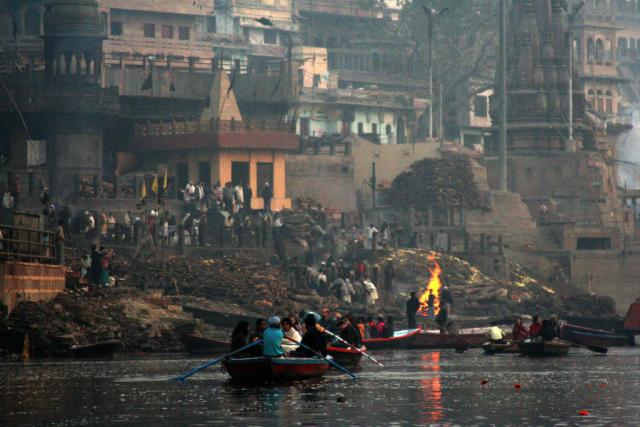
The Ganges runs through Varanasi, and many of the dead are cremated on the wide steps (or “ghats”) that lead to the water.  Some ghats, known as “burning ghats,” are used specifically for this purpose, and it was at one of these that Derek and I witnessed the many stages of a Hindu cremation.  We watched dead bodies swathed in brightly colored cloth being carried through Varanasi’s narrow alleyways and down to the river, where they were doused in the holy waters and then placed upon a pyre fed with wood and fuel.  Upon incineration, societal outcasts employed specifically for funereal purposes threw the ashes into the Ganges’s slow-moving current.  In the case of holy men and children, we learned, the cremation process is bypassed entirely in favor of throwing the bodies directly into the river.  I guess it goes without saying that we found the whole process fairly overwhelming.  Still, we were glad to play witness to this most holy of practices.
city_of_life1
Varanasi seems to be a place better observed than toured.  Rather that visiting every site that our guidebook recommended, we spent our time wandering the city’s ghats, exploring its streets and taking in the life along its riverbanks during an early-morning boat ride.  Like so much of India, Varanasi is equal parts chaos and vibrancy–a photographer’s dream and a place where we felt very lucky to spend a few days.

Varanasi Video

[embedplusvideo height=”350″ width=”450″ editlink=”http://bit.ly/1t0snuQ” standard=”http://www.youtube.com/v/4MhvtcDcX60?fs=1″ vars=”ytid=4MhvtcDcX60&width=450&height=350&start=&stop=&rs=w&hd=0&autoplay=0&react=1&chapters=&notes=” id=”ep6613″ /]

« Previous PageNext Page »