Author Archive

Before we arrived in Ushuaia, Argentina, I knew only that it was the southernmost city on earth–literally, the end of the world–and that Argentine prisoners had once been sent there to maintain Argentina’s hold on the land (presumably because no one else was willing to go).  The place didn’t sound particularly promising…
end_1
But the town has come a long way since the prison was established in 1896.  More than 100 years later, it’s transformed into both a place where Argentinians move to raise their families ((Two decades ago, it had the highest population growth rate in the world!)) and a destination that is fairly popular among tourists. Travelers who come to Ushuaia (most of whom are either backpackers or soon-to-be passengers on one of the cruise ships that docks in the local marina) will find plenty to keep them busy and well fed for a few days.  A quick culinary note: Ushuaia is famous for its king crab, or “centolla.”  Those who know me well are aware of my desperate love for crab.  It’s hard to adequately describe the happiness I felt upon being presented with a heaping plate of the stuff, steamed and already shelled.
end2
Just five minutes outside the city waits Glaciar Martial, which is essentially a moderately sized, glacier-topped mountain with a sometimes-functional chairlift.  (It’s used for skiing during the winter.)  On the day that we chose to climb it, the chairlift was out of commission.  (Unlike when we climbed Volcano Villaricca, however, the malfunction didn’t launch us into despair… It simply meant a brief extension of a pleasantly steep hike.)  The climb itself was spectacular, in part because it allowed for stunning views of the mountain-flanked Beagle Channel that improved with every upward step.  The thing that really amazed us about the hike, though, was that it was just one of many options located within a few minutes of Ushuaia.  The proprietor of our hotel described it to us as “ok.”  Ok?? If this hike were located anywhere in the U.S., we’re certain that–with its fantastic views of mountains, water and a glacier alike–it’d be one of the best around.
end3
Given Ushuaia’s former status as a penal colony, we felt it necessary to pay a visit to the place where some 600 unfortunate souls found themselves incarcerated.  Now titled the “maritime museum,” the prison houses everything from balsa wood models of ships to department store dummies dressed as prisoners to two art galleries, one with a nautical theme, the other best described us “the paintings that likely hung in your hair salon at some point in the early 90s.”  (Think lots of teal and turquoise…)  Some of the cells are open to tourists; they provide a glimpse of just how cold and lonely it must have been to be imprisoned at the end of the world.

[embedplusvideo height=”350″ width=”450″ editlink=”http://bit.ly/1mFIYzV” standard=”http://www.youtube.com/v/Y9maR2-Jqss?fs=1″ vars=”ytid=Y9maR2-Jqss&width=450&height=350&start=&stop=&rs=w&hd=0&autoplay=0&react=1&chapters=&notes=” id=”ep3171″ /]

pucon1
In the middle of Chile’s lake district, at the foot of the ever-smoldering Villarrica Volcano, lies Pucón, a little town whose primary purpose seems to be to cater to the every whim of the backpackers and other adventurous types who flock there.  They arrive in droves every summer and fall ((Chile is in the Southern Hemisphere, which means, of course, that its seasons are the opposite of ours.  So right now, summer is over and we’re well into fall.  I cannot get over the fact that, for Chileans, Christmas comes at the warmest time of year.  How does Santa operate his sleigh?)) to sample some of the many offerings of this extreme sports mecca.   Once they’ve fully exhausted themselves in Pucón’s outdoor playgrounds, they head to its many excellent bars and restaurants to rest up and refuel for the next day’s adventure.
pucon2
We arrived in Pucón with two goals: to improve our Spanish and to spend as much time as possible in Pucón’s Great Outdoors.  Check and check.  We each signed up for two hours a day with a private Spanish tutor at Language Pucón, a wonderful little backpacker-oriented school.  I’m happy to report that, by our last day of class, Derek’s already-decent Spanish had greatly improved and my non-existent skills had sharpened to the point where basic communication was at least within reach.   (I can now spit out such marvels as “My backpack is black” and “I need to buy a bus ticket.”) 
pucon3
When we weren’t in class or doing our homework (Shanna)/making fun of those who do their homework (Derek), we were busy rafting the class IV rapids of the Trancura River and riding horses through the nearby Cañi forest in the company of Rodolfo, a true Argentine cowboy who was brimming with excitement about the weekend’s upcoming rodeo.   Both rafting and riding felt like the best-possible versions of themselves.  The river was cold and clear, and its rapids were dangerous enough to be exciting but not so dangerous as to make us fear for our safety.  The forested hills were astounding, the horses beautiful and patient, and Rodolfo everything I could have pictured an Argentine cowboy to be (complete with a hat, chaps, spurs and a horse-loving dog named Stella). 

In the language of the Mapuche-Pehuenche Indians who dominated the region before the first European settlers arrived in 1883, Pucón means “entrance to the mountains.” Indeed, mountains seem to surround the little hamlet. Look out of pretty much any window in town and you’ll see an amazing landscape behind which the Andes tower.

Pucón has been described as “an Andean version of Aspen,” and, other than the fact that Pucón is more geared to backpackers than it is to the jet set, that’s pretty much what it feels like. Pucón’s streets, like Aspen’s, are lined with upscale restaurants and the occasional boutique. (The ones in Pucón, however, are interspersed with empañaderias and are considerably more affordable than their Colorado counterparts.) In the winter, its slopes are filled with skiers and its cafes packed with those in search of hot chocolate. While the flight to Pucón may be a little longer than the one to Aspen, we’d say that it’s definitely worth the trip!

el_norte5
San Pedro de Atacama is in the southeast corner of the area of Chile known as the “Norte Grande,” or the “Great North.”  The moniker seems an apt description for San Pedro, where everything is, indeed, great in size: the desert stretches on for miles, the sky is immense, even the prices are huge.  ((Having only recently left Asia, where almost everything costs considerably less than it does at home, San Pedro’s prices really jolted us back to reality.  It’d been a long time since we had paid $2 for a bottle of water.))  Only the town itself is tiny–just a few adobe buildings in the middle of the Atacama desert. This place is the most arid on earth.  It hasn’t seen any rain since January, when it rained for about 30 minutes, and the last big rain was–get this–in 2001, when it rained for five hours.
el_norte4
While San Pedro itself has plenty of bars and restaurants, it’s the stuff outside of “civilization” that has tourists arriving in droves.  Every night, just outside of town, the sun puts on the best show around.  As it sets in the Valle de la Luna (or “Valley of the Moon,” so named because of the lunar-like landforms there created by eons of wind and floods), it paints the sky in spectacular shades, each section a different color.  We were lucky enough to see it one night after an amazing hike among the valley’s sand dunes.  To the west were yellows and oranges; turning a bit, we saw pinks and reds; the east was awash in blues and purples. Derek has a habit of describing things by rank.  A truly amazing meal is “one of the top five meals” he’s ever had.  A great hotel might be “one of the ten best” he’s stayed in.  For one of the first times in my life, as we watched the sun setting over the valley’s rolling sand dunes, I heard him pronounce that the sunset was the BEST he’d ever seen.  No rank needed.
el_norte3
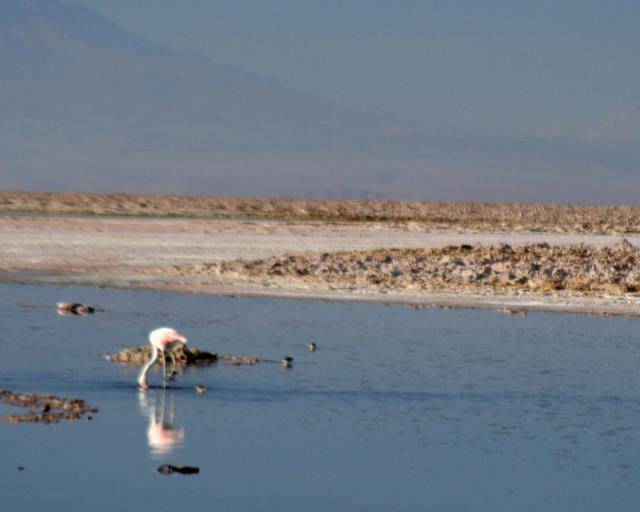
About 40 miles south of San Pedro are the salt flats of the Salar de Atacama.  Like something out of a Salvador Dali painting, weirdly shaped rocks fill the landscape and extend for as far as the eye can see.  In the middle of it all is Lake Chaxa, a lagoon that plays home to three of the five flamingo species.  Only a handful of the pink ((Did you know that flamingos get their color from all of the pink shrimp they eat?  This fact has made me think twice about my massive consumption of cherry red Twizzlers, lest I take on a rosy hue…)) creatures were on hand when we paid them a visit, but I really loved being able to see them outside of the confines of a zoo.
el_norte2
Nearby the salt flats stand Laguna Miscanti and its smaller cousin, Laguna Miniques.  One day, we hiked through the sandy terrain surrounding the lakes for a lunchtime picnic.  A few bites into my sandwich, I realized that we had a guest: a small but determined desert fox watched us from a safe distance, getting ever closer as he realized that we were both harmless and in possession of food to his liking.  And he wasn’t our only companion from the animal kingdom–from a nearby hillside, about eight vicunas (they looked just like llamas to me…) cast watchful eyes over the group.
el_norte
Tourists willing to awake on time for a 4:00 am departure from San Pedro ((This group included me, though I would replace “willing” with “coerced by spouse.”)) can head to El Tatio, the world’s highest major geyser field.  For the price of a few hours of sleep (and a small admission fee), you get to walk through the steam bath created by the world-famous geysers, all of which are located in the collapsed center of a volcano.  ((Allegedly, the early-morning arrival is imperative because, as the morning wears on, winds arise and sweep away the picturesque steam from the geysers.  Given that the steam was still entirely visible by mid-morning, when we left, I find the whole thing a bit suspect.))  This is no American tourist attraction, replete with guardrails and large-print warning signs.  Tatio is a free-for-all where tourists stroll among the thin-crusted geysers at their own risk.  Four have fallen to their deaths in recent years.  Most of the accidents have taken place near a particular geyser, now aptly referred to as “killer.”  This probably was not the best venue for my still-groggy self, but I survived without incident.

This fact is particularly surprising given that Derek and I, in a “you only do this once”-induced moment of insanity, took a plunge in one of the geyser-created hot springs.  The water, though warm, did little to cut the chill of the 30-degree air.  While falling to our deaths wasn’t a real threat (we were there with a knowledgeable guide), catching pneumonia was.  Alas, we survived, and we headed out of San Pedro with little more than good memories and fantastic photographs.

[embedplusvideo height=”350″ width=”450″ editlink=”http://bit.ly/1Acx35d” standard=”http://www.youtube.com/v/qeuJQSe45YA?fs=1″ vars=”ytid=qeuJQSe45YA&width=450&height=350&start=&stop=&rs=w&hd=0&autoplay=0&react=1&chapters=&notes=” id=”ep4422″ /]

[embedplusvideo height=”350″ width=”450″ editlink=”http://bit.ly/1Acx9tm” standard=”http://www.youtube.com/v/4JNY0vQWloY?fs=1″ vars=”ytid=4JNY0vQWloY&width=450&height=350&start=&stop=&rs=w&hd=0&autoplay=0&react=1&chapters=&notes=” id=”ep8009″ /]

A few days ago, in the middle of our 50-hour, epic journey from Bangkok to Santiago, we had a layover in Detroit.  In a way, we felt that we were coming full-circle in this, the middle of our journey: our trip had begun six months before with a flight out of the same airport.  After spending all but four days of those six months in Asia, which often felt very, very foreign, it was nice to be home, even if only in the airport and only for a few hours. 

My parents live in Rochester, a suburb of Detroit, and so they, along with my aunts, my cousin and one of my best friends, met us during our layover.  They came bearing gifts.  Although I was bleary-eyed at the time from 24 hours of flying, I managed to consume embarrassing quantities of Diet Coke (the stuff abroad is not nearly as good as the Real Thing, I swear to you), homemade chocolate-chip cookies (impossible to get on the road) and a full meal from Kruse and Muer, the restaurant whose food I always crave when I´m away from Rochester for too long.  In my few hours on home turf, I tried to soak up as much of the U.S. as possible.  I drank water straight from the tap, secure in the knowledge that it wouldn´t make me sick.  I watched the snow fall.  I luxuriated in the friendliness of the woman who drove the airport shuttle bus.  And, much too soon, it all came to an end and we were waving goodbye and boarding yet another plane, this time to Chile.

For me, our brief foray back into America really broke up the trip.  We´re now at Mile 13.1–half finished with a journey that is much more a marathon than a sprint.  In the past six months, we´ve had countless amazing experiences, a handful of trying ones and quite a few about which the numbers will tell the best story…

  • Countries visited: 16
  • Pairs of shoes worn through: 1
  • Bouts of food poisoning: 2 (Derek); 1 (Shanna)
  • Friends and family members who joined us for a leg of our journey: 10
  • Pieces of luggage destroyed by the airlines: 1
  • Pictures taken (not including the thousands we´ve deleted): 6,423
  • Visits by Shanna to the dentist: 7
  • Mattresses purchased for a Chinese orphanage: 120
  • Electronic appliances lost or stolen: 2
  • Missed flights: 0

luang_2
As the true jewel in Laos’s crown of tourist attractions, Luang Prabang–with a population of only 26,000–is not a big city.  Rather, it’s a small town with a lot to offer the ever-increasing number of tourists who come to wander its idyllic streets, dine in its French-influenced cafes and soak up its incredibly contagious relaxed attitude.  After five days of doing just that, I find that I can sum up our time in Luang Prabang by recalling three great experiences and one that I’m still worrying about.

First, the good stuff…
luang_1
As we meandered through Luang Prabang’s neighborhoods, we came across temple after temple that housed both ancient relics and young novice monks eager to practice their English with passers-by.  Like so many churches in small-town America, the temples felt very much like the center of the town’s community life.  Wat Xieng Thong, a temple just down the street from our guesthouse, was celebrating a once-a-year festival while we were there.  We were lucky to witness the temple’s vibrant religious community performing ceremonies on their own behalf, rather than–as we’ve seen elsewhere–because tourists expected them to do so.
luang4
One day, Derek, Dana–my good friend who joined us on our travels for a couple of weeks–and I took at boat down the Mekong to the Pak Ou Caves.  Docking on the riverbank, we found two caves situated one on top of the other in a limestone cliff.  Both were crammed with Buddha images of all sizes and styles, and a few locals were on hand to pay their respects to these unique additions to the natural world.
luang5
The next day, we all hopped aboard a tuk-tuk and rode an hour through the Laos countryside to the Tat Kuang Si waterfalls.  What an incredible surprise!  You know those glossy brochures that advertise tropical getaways?  They usually feature a happy couple laughing under a waterfall while standing in a turquoise pool of water, surrounded by tropical foliage and brightly colored flowers.  Well, I’d say that there is a fairly strong chance that those pictures were taken at these waterfalls.  They were stunning and, because we arrived just as the park that houses them was opening, we had them nearly all to ourselves.  A random but fantastic bonus were the caged bears and tiger that greeted us at the park’s entrance.  Rescued from poachers, they now live out their days in large habitats under the protective watch of the park staff.

And now, the worrisome part…
luang_3
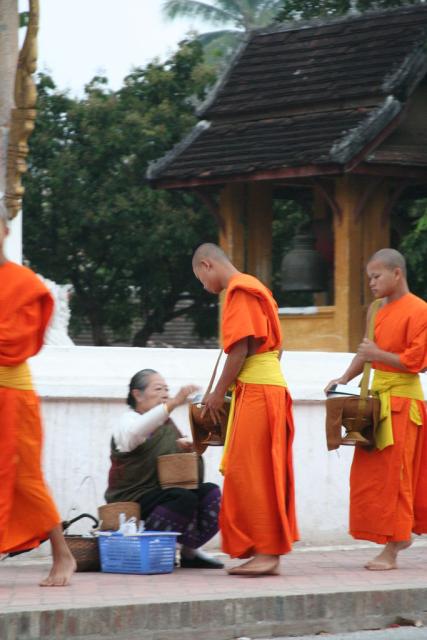
On our last morning in Luang Prabang, we woke up early to witness a ritual that surely has been taking place for as long as the townspeople can remember.  Every morning, just after 6:00 a.m., hundreds of monks line up and walk down the main street, collecting offerings of food that will serve as their meals for the day.  In their saffron-colored robes under the early-morning sky, the monks are a sight that most everyone would want to see.  And that’s just the problem: everyone does.  Tourists piled off of buses and onto plastic stools placed along the road for them by enterprising tour operators.  With their flashing cameras and their frantic efforts to capture every move that the monks made, they would have put the American paparazzi to shame.  And I admit: we all did our part to add to the madness.  We guiltily snapped pictures and took videos alongside the rest of the onlookers, only adding to the sense that the monks had way too much in common with the caged animals we saw at the falls–lovely to look at and permanently on display.  And therein, I suppose, lies one of the biggest paradoxes of independent travel: we all want to witness (and photograph) unique, authentic occasions.  We just wish that everyone there to do the same would stop ruining the experience for us.

[embedplusvideo height=”350″ width=”450″ editlink=”http://bit.ly/1AczkgF” standard=”http://www.youtube.com/v/nAQrT43I2mY?fs=1″ vars=”ytid=nAQrT43I2mY&width=450&height=350&start=&stop=&rs=w&hd=0&autoplay=0&react=1&chapters=&notes=” id=”ep2128″ /]

[embedplusvideo height=”350″ width=”450″ editlink=”http://bit.ly/1AcA2dN” standard=”http://www.youtube.com/v/6UQx84XRAuo?fs=1″ vars=”ytid=6UQx84XRAuo&width=450&height=350&start=&stop=&rs=w&hd=0&autoplay=0&react=1&chapters=&notes=” id=”ep3084″ /]

Our travels thus far have taken us to a number of places marred by the aftermath of politics gone wrong.  In no place, however, have the wounds from such wrongs been as raw or as recent as the ones we witnessed during our time in Phnom Penh, Cambodia.
a_macabre1
In the late 1960s and early 1970s, Cambodia was engulfed in a civil war that created a power vacuum into which an orthodox Communist group called the Khmer Rouge ((More than 90% of Cambodia’s population is of Khmer origin and speaks the Khmer language.  “Khmer Rouge” means “Red Khmer” in French.)) stepped into in 1975.  Over the course of the next four years, the Khmer Rouge carried out a radical program that included isolating the country from foreign influence, closing schools, hospitals and factories, abolishing banking, finance and currency, outlawing all religions, confiscating all private property and relocating people from urban areas like Phnom Penh to collective farms where forced labor was widespread.  During this time, the Khmer Rouge, under its leader, Pol Pot, overworked and starved the Cambodian population, executed those who ostensibly had the potential to undermine the new state (including intellectuals or even those who exhibited stereotypical signs of learning, such as eyeglasses) and detained and killed many others for even minor breaches of their stringent rules.
a_macabre_2
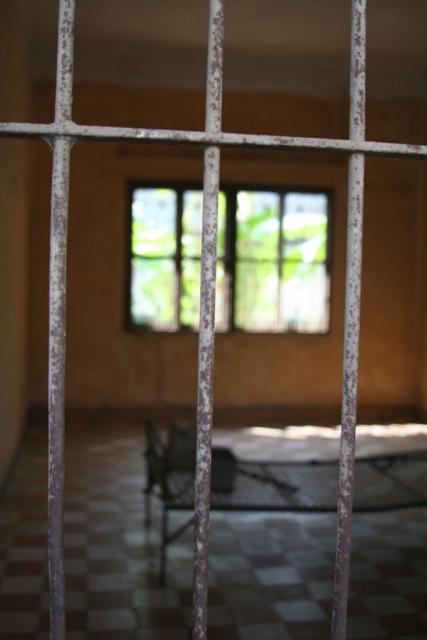
We spent a day visiting two of the sites where many of these atrocities took place.  We toured a former high school that was commandeered by Pol Pot’s forces and turned into a prison camp known as S-21.  Approximately 17,000 people passed through the camp, which is now known as the Tuol Sleng Genocide Museum, before being executed.  (Of all those imprisoned at S-21, only ten are known to have gotten out alive.)   The school’s classrooms were converted into tiny prison cells and larger interrogation centers, where prisoners were tortured (mostly by Khmer Rouge children aged 10 to 15) and forced to confess crimes that they had never committed.
a_macabre_3
Once condemned to death for their “crimes,” the detainees were sent to be executed at one of the many killing fields that the Khmer Rouge established throughout Cambodia.  We visited Choeung Ek, one such field and the place where more than 15,000 people were believed to have been murdered and buried in mass graves.  A powerfully disturbing memorial at the site features a glass case that contains the skulls and bones of more than 8,000 of the victims.
a_macabre_4
The Khmer Rouge was ousted by Vietnamese forces in 1979, but it retreated west to a safe haven near the Thai border, where it remained (and ruled) for the next ten years.   Party infighting led to its eventual disintegration and to the imprisonment (by house arrest) of Pol Pot, who died in 1998.  While many other Khmer Rouge leaders either surrendered or were captured, some are still believed to be hidden in Phnom Penh.  Interestingly enough, Cambodia’s population is very young, and so, by 2005, more than 75% of its population was too young to remember the years during which the Khmer Rouge held their nation under siege.

Those who live in Phnom Penh now walk the streets of a surprisingly cosmopolitan town that is the wealthiest and most populated in Cambodia.  While the city is rife with poverty, most of the short-term tourists (ourselves included) who populate its trendy cafes and bars remain, for better or worse, almost completely isolated from the city’s modern-day troubles.

[embedplusvideo height=”350″ width=”450″ editlink=”http://bit.ly/1sVdp9s” standard=”http://www.youtube.com/v/wpXGAnEFP6Y?fs=1″ vars=”ytid=wpXGAnEFP6Y&width=450&height=350&start=&stop=&rs=w&hd=0&autoplay=0&react=1&chapters=&notes=” id=”ep2004″ /]

taking_1
We’ve been traveling for almost six months now and among the many lessons we’ve learned is this: travel can sometimes feel like a full-time job. Okay, like a really good job where we have neither assignments, deadlines nor specific working hours, but all the same, finding places to sleep each night, navigating new places every day, deciding where to eat every meal and making sure that we see everything we can in every place we visit can take its toll after awhile. Happily, we have the freedom to leave all of that behind for a few days and take a vacation within our vacation. And that’s just what we did for two days in Nha Trang and a few more in Phu Quoc.
taking_2
A westernized beach town on the southeast coast of Vietnam, Nha Trang boasts rows of hotels where guests lounge by the pool by day and a plethora of beachfront bars and restaurants where they migrate at night.  We were pleasantly surprised by Nha Trang, as other travelers had given it fairly mixed reviews.  Although it’s certainly not the place for you if you’re looking to experience “Authentic Vietnam,” the long stretch of beach is clean and dotted with manicured gardens, making for a picturesque escape from the bustling, pre-Tet crowds in Vietnam’s larger cities.
taking_3
A better choice for those looking to steer clear of the beaten tourist path, Phu Quoc Island sits in the Gulf of Thailand, off of the southwest coast of Vietnam.  Rumor has it that huge hotel complexes are headed its way in the near future but, for now, laid-back beachfront bungalows share the island with forests, mountains and a sizeable military base (necessary to prevent Cambodia, which claims the land as its own, from encroaching on Vietnamese interests).  Derek and I spent a day scuba diving ((Our review of Phu Quoc diving: Enjoyable, but not alone worth the trip to the island.  The water was so clouded with sediment that, at times, we felt like we were swimming through a snow storm.)) and the rest of our time lazing by the beach and walking the miles of sandy shoreline.  At the end of our time in the sun, we were fully recovered from any travel-related stresses and ready to continue on with our adventure.  

good_morning2
Our visit to Vietnam would not have been complete without a trip to the demilitarized zone, or DMZ.  This strip of land, which is approximately two miles wide, divided North and South Vietnam before and during the Vietnam War (or, as it’s called here, “the American War” or, depending on the speaker, “the War of American Imperialism” or similar). It thus separated Ho Chi Minh’s Viet Cong (VC) in the north from the American and South Vietnamese forces down south.

Nearly every American of our generation has friends and loved ones whose lives the war changed forever.  Our uncles and our fathers served there (as did a few thousand women), and we’ve seen its lasting impact on them.  We’ve grown up watching movies about the battles waged from 1963 to 1973 and hearing stories about the discord the war prompted back at home.  While Derek, Alyssa and I knew the basic outline of what took place during those troubled years, there was nothing like a field trip to the actual war zone to make it all hit home.

At 6:00 a.m. one morning, we boarded a bus full of tourists (some American, some non-) and set off for the DMZ, not really knowing what to expect.  At the end of the day, we had not only seen the sights, we had learned an important lesson about how cultural perceptions can influence the retelling of history.
good_morning1
Our pint-sized guide (he maybe came up to Derek’s elbow) had a father who fought for the North and uncles who enlisted for the South. Like his American counterparts, he had grown up in the shadow of the war, only–given his geographic location—much more so.  Born and raised in post-war Vietnam, he saw on a daily basis the physical destruction that the war caused, and he told us that his father died from the effects of Agent Orange.  Needless to say, playing witness to the war’s devastation left him less than impartial: many of the facts he recited to us contrasted sharply with those in our Australian-written guidebook, and he peppered his spiel with adjectives that made the Americans on board bristle a bit.

For me, one of the most interesting parts of the tour was the time we spent at the Khe Sanh Combat Base.  Americans of our parents’ generation will remember Khe Sanh as the marine stronghold that President Johnson, in 1968, feared would soon be the site of a massive Viet Cong siege.  The media took up the cry; Newsweek and Life both did cover stories on the impending attack.  Huge supplies of planes, troops and ammunition were amassed to ward off the threat from the North, but it never really materialized as planned (the siege was much smaller than expected).  Many scholars now believe that the VC threatened to attack Khe Sanh in order to distract US forces while the VC readied itself to launch the now-famous Tet Offensive. As it turned out, the comprehensive attacks that the North launched during the Tet holiday that year severely wounded the US and its allies and, according to many, mobilized American public opinion against the war.
good_morning_3
Khe Sanh now plays home to a small museum that prominently features pictures of Vietnamese soldiers doing various activities that, according to the captions, “Caused the Americans to flee in panic.”  The comments in the museum’s guestbook were at once intriguing and heartbreaking.  In addition to the usual “Peace Now” and “Down with the American Imperialists” messages were words from widows of American soldiers, from a mother whose son had been killed at Khe Sanh and from a U.S. Brigadier General named Tommy Bell: “I fly 243 missions here during 1966-1967.  We may have killed two million Vietnamese.  For this I am very sorry.  I will never fight another war.”  Those comments will stay with me far longer than anything I might have read in a history book.
good_morning4
After brief stops at the Rockpile and Dakrong Bridge, our bus pulled up to the Vinh Moc tunnels–almost 2 miles of underground passageways in which North Vietnamese women and children lived during the war, largely protected from the bombs that rained above their heads.  Not a place for claustrophobics, the dark tunnels are about five and one-half feet tall and maybe three feet wide.  They form a sort of warren, complete with meeting rooms, living areas and a maternity ward where 17 babies were delivered during the war years, only to spend the first years of their lives entirely underground.

All in all, our day in the DMZ allowed me to glimpse the vast differences between American and Vietnamese perceptions of the war.  Particularly given the debates over our country’s current involvements on foreign soil, it also afforded me a timely and much-needed history lesson. Now it’s time to hit the books in search of answers to the many questions raised by our time in a place where so many soldiers–American and Vietnamese alike–gave their lives in service to their country.

[embedplusvideo height=”350″ width=”450″ editlink=”http://bit.ly/1sVbNN5″ standard=”http://www.youtube.com/v/4kONfahralY?fs=1″ vars=”ytid=4kONfahralY&width=450&height=350&start=&stop=&rs=w&hd=0&autoplay=0&react=1&chapters=&notes=” id=”ep4238″ /]

perfume2
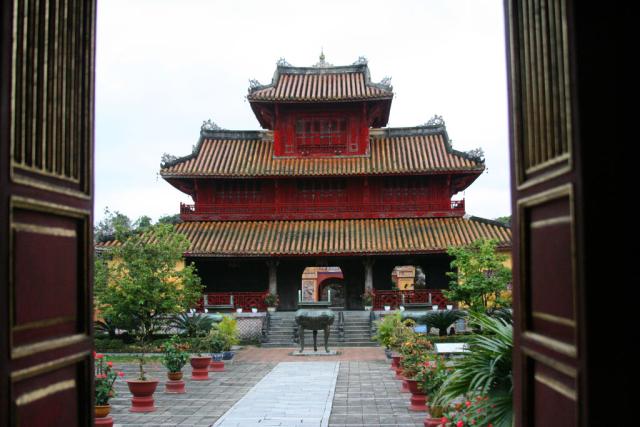
After Hanoi, we flew to Hue, a former imperial city on the banks of the enigmatically named Perfume River.  We spent a mist-filled afternoon exploring the Citadel, a section of the city that is surrounded both by a moat and by tall, thick walls.  These safety precautions did little to defend the area from the Vietnamese-American War; huge swaths of the Citadel were razed during one of the bloodiest battles of the 1968 Tet Offensive.  Tourist dollars are helping to fund ongoing restoration efforts, and the results are already visible throughout the complex.  The Imperial City, a Citadel-within-a-Citadel that once housed the emperor’s residence and important state buildings, looked like a run-down version of Beijing’s Forbidden City but was remarkably free of the hordes of tourists that we’d seen there.
perfume
Hue is known for its food, and we were all eager to (over-)indulge.  We didn’t find too much worth, um, writing home about, but perhaps we were just looking in the wrong places.  We did discover some great snacks at the local market, which buzzed with frenetic shoppers making last-minute purchases for the upcoming Tet celebrations.  Armed with sugary coconut strips and dried, shredded beef (it’s good–seriously…), we left Hue for what, we hope, will be the sunnier skies of Southern Vietnam.

[embedplusvideo height=”350″ width=”450″ editlink=”http://bit.ly/1t0nQbG” standard=”http://www.youtube.com/v/nOi5AsvCgQQ?fs=1″ vars=”ytid=nOi5AsvCgQQ&width=450&height=350&start=&stop=&rs=w&hd=0&autoplay=0&react=1&chapters=&notes=” id=”ep4504″ /]

Google Video

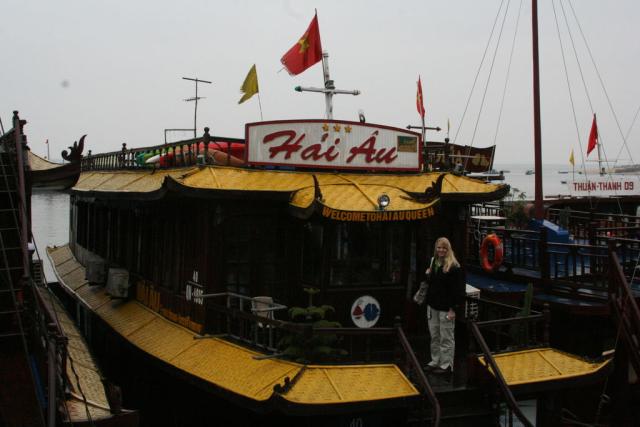
Hai Au Queen Boat in Halong Bay
In the green-gray waters of the Gulf of Tonkin sit the more than 3000 limestone karsts that combine to form the wonder that is Halong Bay. The bay has long been a draw for tourists visiting mainland Vietnam; most of us hop on buses in Hanoi and, after a long ride through rice fields and pastel, dollhouse-like homes, step aboard rickety boats (called “junks”) for some time on the open water. That’s exactly what Derek, Alyssa–my best friend who’s traveling with us for a few weeks–and I did a few days ago.  Hurrying through the fine mist that has seemed ever-present during our stay in Vietnam, we boarded the Hai Au and set off to explore the karsts.
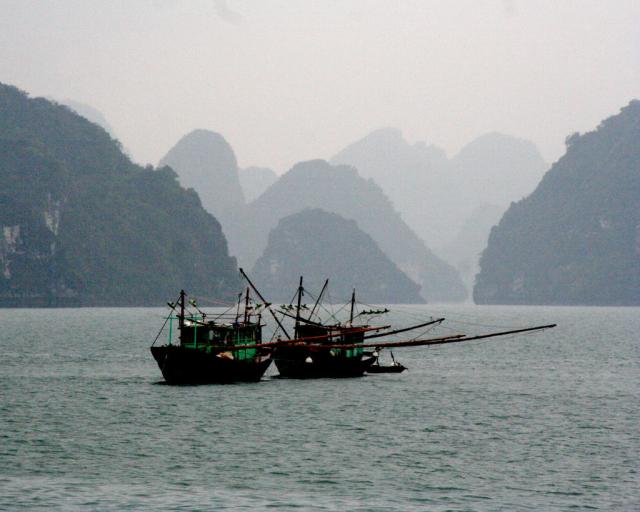
Halong Bay
Derek and I had biked through karsts in Yangshuo, China, but seeing them by boat was a different experience entirely.  The tiny, colorful fishing boats anchored in front of the towering karsts create a stunning, almost ethereal landscape, and rumors of a Halong Bay-based Loch Ness monster only increase the intrigue.  (Sadly, if he’s out there, we never spotted him.)

The junk stopped at the three-chambered Hang Sung Sot cave, known to tourists as “Surprising Cave,” likely due to the, err, adult nature of one of the rock formations within.  After exploring the cave, we braved the chilly air and paddled kayaks through a tunnel in one of the karsts and into an idyllic lagoon.  Later, we warmed up over endless games of Uno, which is quickly becoming my favorite travel pastime.  Our captain dropped anchor in the bay for the night, and we all fell asleep to the sound of waves lapping against the boat–not a bad lullaby at all!

[embedplusvideo height=”350″ width=”450″ editlink=”http://bit.ly/1pAD6ge” standard=”http://www.youtube.com/v/eNth54ieVK8?fs=1″ vars=”ytid=eNth54ieVK8&width=450&height=350&start=&stop=&rs=w&hd=0&autoplay=0&react=1&chapters=&notes=” id=”ep3773″ /]