Author Archive

After several days in Luang Prabang, Laos, we caught a short flight to Chiang Mai in Northern Thailand where we immediately boarded a minibus headed towards the mountain town of Pai (pronounced “bye”). The road from Chiang Mai to Pai is legendary – three hours of countless hairpin turns that combine to create one of the best motorcycle rides in the world. As I stared out the window keeping my eyes focused on one object in order to quell the feelings of motion sickness, I momentarily thought I was back in Tennessee driving through the Smoky Mountains on my way from Gatlinburg to Cades Cove – the geography was strikingly similar.

Pai has achieved legendary status among the backpacker, hippie crowd. Its idyllic climate in a spectacular mountain setting combined with ridiculously cheap prices and all the amenities a backpacker craves (including abundant Internet cafes and travel agencies, day trips galore and a friendly, tolerant community) keeps travelers staying here for much longer than originally anticipated. We met several travelers who have stayed here for months at a time and continue to return here year after year. I understand the appeal. While I’m about as far away from a hippie as someone can get, I do enjoy the laid-back feel that the backpacker community generates.
a_slice_2
After a three days of doing virtually nothing in Pai (other than an eventful elephant ride by Shanna and our friend Dana–Shanna’s elephant threw her over its head and into the river…twice) and a couple of days in Chiang Mai doing the same, we flew to Bangkok and headed straight to the most famous backpacker spot on the planet – Khao San Road. Due to Bangkok’s central location in Southeast Asia, backpackers tend to wind up in Bangkok several times during any trip to the region. Needing a cheap place to stay, travelers found a few, cheap guesthouses on Khao San Road (a small street conveniently located near most of the can’t-miss sights of Bangkok) a few decades ago. In the past twenty years, Khao San Road and the surrounding area have exploded with hundreds of guesthouses, restaurants (including the addition of Burger King and McDonald’s, inflaming many in the hardcore crowd), bars, Internet cafes and travel agencies.
a_slice
Khao San Road may be the most diverse place in the world and is my number one place to people watch. Sitting in a roadside cafe for just a few minutes, you might see a young German couple passing through Bangkok on their way to the islands of Southern Thailand, a Thai hipster with pink hair, an aging hippie trying to relive his glory days when he came to Bangkok in the 60s, a wide-eyed 18-year old woman from England just starting out on her “Gap Year” ((In England, many high school graduates take a year off to travel the world before they head to college. The practice is so common that the term “Gap Year” has become common in England and has spread elsewhere in Europe and Australia. I fear the term will never gain traction across the pond…)), a dreadlocked Australian and even…a couple of 30-something lawyers from the States.

A visit to places like Pai and Khao San Road draws strong reactions. Many people despise these communities, commenting that these places are not the “real” Thailand or whatever other country in which they may be located. Others understand that, of course, they are not “real”, but they are a community nonetheless where fellow travelers can momentarily escape the stress that traveling in a foreign environment for a lengthy period can sometimes create. Regardless of a vistor’s reaction, travelers tend to keep coming back, seemingly incapable of avoiding their unique and sometimes overwhelming draw. Given that Shanna and I have already been to Khao San Road twice in as many years, I’d say the same is true for us.

2276|350

Angkor, the Sanskrit word for “city,” was by far the largest city in the world in the pre-industrial era, covering an area of over 1,000 square miles.  Between 900 and 1200 AD, the kings of the Khmer empire built over a thousand buildings in Angkor, from small, nondescript temples now reduced to rubble to Angkor Wat – the largest single religious monument in the world.  When the Frenchman Henri Mouhot came across Angkor Wat in the mid-1900s, he said that the Angkor Wat temple “- a rival to that of Solomon, and erected by some ancient Michelangelo — might take an honourable place beside our most beautiful buildings. It is grander than anything left to us by Greece or Rome, and presents a sad contrast to the state of barbarism in which the nation is now plunged.”

2231

The Khmer empire began its decline in the 14th century ((There are several theories as to the cause of the decline, including repeated invasions by Thailand (its neighbor to the West) and urban mismanagement, leading to an inadequate supply of water for its hundreds of thousands of inhabitants)), ultimately leading to an abandonment of the city in the mid-1400s.  Without upkeep, the buildings began to fall apart and to be overtaken by dense jungle.  It wasn’t until the early 1900s that a French team began to restore the buildings of Angkor.

2288

After years of war and political turmoil, tourists have descended on Cambodia – usually staying for 1 or 2 days in Siem Reap, a small town only a few miles from Angkor.  Last year alone, two million visitors visited Angkor Wat and, considering the tremendous construction of hotels and restaurants in the area, more are expected.  ((The growth in Siem Reap has been extraordinary.  When I first visited the city in 2004 – just four years ago – there were only a handful of hotels and restaurants.))  For those who make the trip, they will not be disappointed.

We joined the droves of tourists for the obligatory sunrise viewing of Angkor Wat.  Arising at 5:30 a.m., we made our way to the pond located to the front left of the temple.  In a spontaneous moment of genius, Shanna suggested we get away from the crowds and go inside the temple complex before the masses arrived.  Incredibly, no one else had this idea.  We entered the deserted temple, snapping pictures with reckless abandon.  After a few minutes of blessed solitude, we finally came across two tourists – Virginia Madsen (one of the stars of the movie “Sideways” – she played the character “Maya”) and her son.  After a quick conversation and the obligatory photo with a celebrity, we sprinted back to the pond to snap a few sunsrise pictures.

2279

We spent the next two days visiting temples in the early morning and the late afternoon, choosing to relax by our hotel’s pool and avoid the hot, midday sun of Cambodia.  ((For those planning on visiting, Angkor is best done in 2 or 3 days, even though most tourists try to see it all in one, exhausting day.  You can get temple-fatigue very quickly, so a more leisurely pace is highly recommended.))  In the evenings, we ate some amazing (and cheap) meals at restaurants that seemed out of place – with the decor and quality that would make many New York and Paris-based diners very jealous.

2282

While many of the temples are worth a long visit, my favorites are obviously Angkor Wat, followed closely by Ta Prohm and the Bayon.  In order to give visitors a sense of the state of the temples when first visited by the French explorers in the mid-1800s, Ta Prohm has been left mostly in its condition when found beneath the jungle overgrowth.  Literally, trees had overtaken the temple and the distinction between stone and tree becomes blurred.  This leads to an eerie quality that was recognized by Hollywood filmmakers and led to the filming of Tomb Raider (starring Angeline Jolie) at the temple.

The Bayon temple, located in the walled city of Angkor Thom, is extraordinary due to the dozens of towers constructed with bas-relief faces pointing in all directions.  Each face, considered by many to be the face of Jayavarman – the greatest of the Angkorian kings – has an all-knowing look and a smile that seems content that his legacy, while forgotten by the world for over 500 years, is ensured of never being forgotten again.

[embedplusvideo height=”350″ width=”450″ editlink=”http://bit.ly/1AcAHMa” standard=”http://www.youtube.com/v/4HmoGY6sf04?fs=1″ vars=”ytid=4HmoGY6sf04&width=450&height=350&start=&stop=&rs=w&hd=0&autoplay=0&react=1&chapters=&notes=” id=”ep4399″ /]


No one ever said that independent travel is easy.  For the uninitiated, it can be painfully stressful.  Piecing together the logistics of getting from point A to B to C and so forth can test the patience of even the most laid-back of individuals. 

For most Americans, vacation is the chance to escape from the stress back home, to relax and have everything taken care of.  The most difficult decision the typical traveler wants to make is whether to order steak or fish.  I’m wired differently.  Oddly, my relaxation and recharge comes from making decisions on the fly, from getting out of my element and testing myself.  In all of the vacations I’ve taken over the past decade, I’ve eschewed planning in advance, preferring rather to show up and see what happens.   Sometimes that means that there are no rooms in your hotel of choice, the plane is full or the bus doesn’t leave until tomorrow – these inconveniences have usually led to my favorite travel memories.
getting_there_is2
Our experience a few days ago is a great example of the complexity and tribulations that independent travel can entail.  After a couple of days on Phu Quoc Island off the coast of Vietnam, we wanted to make it to Phnom Penh, Cambodia.  After consulting our guidebook and an online travel forum, we discovered that we could cross the border into Cambodia via boat.  I’ve never crossed a border via a river, so it sounded like something I needed to add to my travel checklist.

After checking out of our guesthouse, we caught a bus to the island ferry.  Unusually, we had taken the step of reserving a seat on the ferry in advance.  Typically, this is unnecessary in Asia since they’ll pretty much let anyone on for the right price. (As becomes important in a second, however, we only had the receipt from the travel agent to prove that we’d already purchased tickets. The agent had assured us that we would be able to exchange the receipt for tickets once we arrived at the ferry dock.) 

As we attempted to board the boat, the ticket taker asked for our tickets. We handed him our receipt from the agent; he said this wasn’t valid and that we needed actual tickets.  After 20 minutes of conversation in broken English and approximately 13 phone calls with our travel agent, it was clear that we weren’t getting on the boat (the last one of the day) without a ticket.  In fact, they refused to even talk to us, physically blocked the ramp to the boat and started to lift up the anchor to set sail.  As all hope quickly vanished, I spotted our white night riding a motorbike down the pier.  As he dismounted, he flashed 3 shiny boat tickets.  Without hesitation, I grabbed them from his hands, brushed the boatman aside and boarded our vessel. 
getting_there_is
Upon arrival on the Vietnamese mainland, we needed to get to the bus station.  The taxi drivers at the boat dock were part of a monopoly that would have made Microsoft and Comcast proud – the price was fixed at exorbitant rates.  After some unsuccessful bargaining, we noticed several motorcycle drivers who were standing near the taxis.  Within a few seconds, we (and our large backpacks) were each on the back of a Honda.  After racing through the city, we were dropped off at a gas station where our bus had stopped for a quick fill-up.  The friendly motorcycle drivers helped us carry our bags onto the bus. 

Three hours and two buses later, we arrived at the bus station in Chau Doc – a Vietnamese/Cambodian border town.  Since it was dark, our border crossing would have to wait until the next morning.  Thus, we flagged down some motorcycles and made our way to a guesthouse referenced in our guidebook.  Luckily, rooms were available for a hefty $6 a night. 

The next morning, I awoke early to my first bout of food poisoning on the trip.  It was not one of my greatest moments.  As I tried to piece together my food consumption from the prior day in order to locate the vile culprit of my violent regurgitation, I realized that I had not eaten any meat the prior day – only bread, corn and fried rice.  Since this was probably the first day in twenty years that I have been completely vegetarian, I swore that I would never forsake meat again.

As I was lying incapacitated on the bed, Alyssa entered the room at 7:26 a.m. and told me and Shanna that our 8:00 a.m. boat to Cambodia was actually leaving at 7:30 a.m.  I’ve seen television shows where humans exhibit super-human powers in times of great emotional distress (e.g., lifting a soon-to-explode car off of a trapped passenger), but I never knew that I was capable of such powers.  However, within 84 seconds I was off the bed, packed and headed towards the door.  We grabbed a cyclo (basically, a guy on a bike with a seat behind him) and were off to the boat dock.  Arriving at 7:32 a.m., we sprinted to the dock desperately hoping that the boat driver had also fallen prey to the sickness caused by forsaking meat.  Luckily, he had.  The boat didn’t leave until around 9:10 a.m.!

The remainder of the journey to Phnom Penh was pleasant – passing simple villages on the banks of the Mekong and leaving Vietnam and entering Cambodia via the river. 

They say that getting there is half the fun; for me, it’s more like 73%.

oh_chi_1
When I first visited Ho Chi Minh City (formerly known as Saigon) with my parents back in 1996, I was mesmerized.  Decades of French rule ending in the mid 1950s and a massive presence of American military during the 60s and early 70s have combined to create a city steeped in history.  In 1996, the streets were jammed with thousands of people heading to various destinations via bicycle, with the occasional motorcycle ridden by the Vietnamese elite.  The only signs of Western influence were the few French-era buildings and hotels that were mostly in need of renovations and a paint-job.
ohchi3
Wow, how things have changed!  In the past 12 years, the economy of Vietnam has skyrocketed.  With investments flowing in from around the world (including the United States), the Vietnamese have been able to increase their standards of living exponentially.  Bicycles have been replaced by countless motorcycles, and the Vietnamese elite now drive European sedans.  On almost every corner, there is a French bistro, sushi restaurant, boutique hotel or jazz club.  The city is virtually unrecognizable from a little over a decade ago.
ohchi4
Our time in Ho Chi Minh City coincided with the climax of Tet, the Vietnamese New Year (for all of you rat-lovers, you’ll be happy to know that this year is the Year of the Rat).  Our guidebooks had warned us that the city shuts down during the holiday as families spend time together in their homes; the streets would be deserted.  Lies!  The roads (and sidewalks…) were filled with motorcycles, typically carrying 3 or 4 passengers ((After witnessing 4 passengers on one bike, we were intent on finding a bike carrying 5.  Luckily, a 5-passenger bike was spotted soon after our search began, followed by a 6-passenger bike a few days later.  I’m not sure the good people at Honda knew that a family of 6 would utilize its scooter for a family outing.)), and Vietnamese families packed the streets much like New Yorkers pack Times Square on New Year’s Eve.  At many times, it was difficult to even move.  You could feel the excitement of a people who know their country is in good times and only headed for better.
oh_chi2
The city is renown for its many pagodas, or temples.  Little did we know that it is a tradition to visit the pagodas during Tet.  As we arrived at a nearby pagoda, we were overwhelmed with the throngs of Vietnamese who had come to show respect to their ancestors.  Inside the pagoda, there are small plaques with the name and picture (and, in some cases, an urn carrying the ashes) of a deceased relative.  The visitor waves a few sticks of incense in front of the plaque, bows and, in some cases, leaves an offering of an item that the ancestor enjoyed (e.g., fruit, cookies or even beer).

The remainder of our time in the city was spent at the other main sites including the Presidential Palace, where the President of South Vietnam resided prior to the end of the Vietnam War, and the War Remnants Museum, a museum displaying some fairly brutal and grotesque pictures from the Vietnam War, with captions that were only a bit more objective than the ones we had seen at the DMZ.

Given its vibrant culture, its energy and the many opportunities it offers to experience history firsthand, I can’t help but think that we’re going to Miss…Saigon (pun most definitely intended).

[embedplusvideo height=”350″ width=”450″ editlink=”http://bit.ly/1sVcqGg” standard=”http://www.youtube.com/v/iveOfkIzOkM?fs=1″ vars=”ytid=iveOfkIzOkM&width=450&height=350&start=&stop=&rs=w&hd=0&autoplay=0&react=1&chapters=&notes=” id=”ep4733″ /]

Carrying cumquat trees for Tet
Hanoi is a city difficult not to love.  After finding a hotel in the Old Quarter, we set off exploring its narrow streets.  Historically, each street in the Old Quarter was devoted to selling a certain product, from which it received its name – Flower Street selling flowers, Shoe Street selling shoes and Fish Street selling an array of freshly caught fish.  Around every corner, you are bombarded with sights and smells that are quintessentially Asian.  Outside the Old Quarter, you will find a fairly modern city filled with government buildings (Hanoi is the capitol city of Vietnam), beautifully restored temples and French colonial buildings and gorgeous, tree-lined lakes.
Streets of Hanoi
For us, Hanoi’s vibrance was only enhanced by the upcoming holiday of Tet.  For the Vietnamese, Tet is THE holiday.  Celebrated on the days before and after the start of the Lunar New Year (which falls on February 7th this year), it is when almost everyone returns home to their families.  For a traveler, it is a unique time to be here.  The whole city of Hanoi was filled with vendors selling flowers on every empty sidewalk, markets filled to the brim with shoppers buying food made only during this time of year and streets packed with motorbikes and people trying to make all their last-minute purchases.

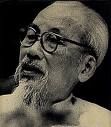
In addition to its many temples and lakes, one of Hanoi’s big draws is the Ho Chi Minh Mausoleum.  Ho Chi Minh is a hero without rivals in Vietnam.  After founding the Community Party in Vietnam, he made it his mission to expel the French colonists from the country.  Ultimately, the French left Vietnam after being defeated by Ho and the gang in 1954 at the battle of Dien Bien Phu, ensuring that Ho would be worshipped as Vietnam’s saviour for generations to come.
Streets of Hanoi
You can’t walk 100 feet in Hanoi (or in virtually every other city in Vietnam) without seeing a statue of Ho or a building or road named after him.  The ultimate memorial is located in a beautiful park in the center of the city where, in a small building, Ho Chi Minh’s body has been embalmed and is open for viewing.  It is an odd memorial to a man who lived a fairly simple life and had specifically requested a basic cremation.

As you are rushed through the small room where his body lies, you are required to dress appropriately, walk quickly, not carry anything with you (especially cameras and phones) and maintain complete silence.  I was especially concerned with this last requirement since silence has never been a virtue of Shanna’s.  Sure enough, within seconds of entering the mausoleum Shanna began talking only to be quickly hushed by one of the many gun-wielding guards.  As I walked past Ho’s body, I was struck by the peaceful nature he exhibited and by his remarkable resemblance to Colonel Sanders.  Perhaps KFC Vietnam has found its mascot?

ringing3

ringing1


[embedplusvideo height=”350″ width=”450″ editlink=”http://bit.ly/1sVdp9s” standard=”http://www.youtube.com/v/wpXGAnEFP6Y?fs=1″ vars=”ytid=wpXGAnEFP6Y&width=450&height=350&start=&stop=&rs=w&hd=0&autoplay=0&react=1&chapters=&notes=” id=”ep3329″ /]

who_needs1
After flying out of India and enjoying a couple of rejuvenating days in the cosmopolitan city of Bangkok, Thailand, we boarded a plane to the largest city in Southern Laos – the bustling metropolis of Pakse (population 66,000).  Laos (pronounced like “cow”, but replacing the “c” with an “l”) is a country that has been off the tourist track for…well…ever.  It is quickly starting to attract tourists, but mainly to the Northern part of this small country.  We decided to start in the more remote South, with plans to visit the North a few weeks from now.

As a landlocked country (bordered by China, Thailand, Vietnam and Cambodia), it’s difficult to imagine that Laos’ island life is one of its main attractions.  However, the mighty Mekong River flows through the length of the country, widening at parts to allow islands to form and sustain life.
whoneeds_3
After renting a motorbike for $7 a day, we started down a newly paved road to the island of Don Daeng.  As we were approaching the island, signs for a new lodge in the area began to appear.  Curious, we found a phone, rang the lodge and were on a small boat to the place just a few minutes later.  Riding down the dirt path to the lodge (no cars are allowed on the island, and there are only a smattering of motorbikes), we passed villages that surely haven’t changed much in a hundred years (the island just got connected to the electric grid 2 months ago, so it will be interesting to see how quickly it changes).  A few minutes later, we arrived at La Folie Lodge and discovered a piece of heaven.

The Lodge consisted of 12 bungalows decorated as well as any 5-star resort, a restaurant serving amazing Laotian and French food and a pool that will no doubt make the pages of Conde Nast Traveler magazine in an upcoming issue.  With initial plans to stay just one night, we quickly checked the availability at the lodge and decided to stay three.  Our days were spent lounging by the pool, watching the gorgeous sunset over the Mekong River and riding bikes around the island.  With tourists still a novelty, we were bombarded by village children running out of their huts yelling “Sabadee” (the Laotian word for “hello”) as we pedaled by, their faces lit up by welcoming smiles.
who_needs5
In need of some lunch, we stopped at a hut filled with a group of screaming men huddled around a small ring.  Intrigued, we stood on chairs and looked down in the ring to witness a cockfight in progress.  I quickly scanned the crowd for to see if Michael Vick was there; unfortunately, he was absent.  After briefly watching the bloody battle between the angered, but perplexed, roosters and the even more spirited battle between the onlookers who had gambled on one of the two birds, we somehow still had an appetite.  We ordered a bowl of noodle soup and finished the bowl while conversing in broken English and Lao with a local who seemed more intent on finishing his bottle of rice whiskey than participating in the cockfight spectacle a few feet away.
who_needs4
After leaving Don Daeng, we continued South via motorbike.  About an hour into our ride, we heard an explosion.  We slowly stopped the bike and realized that our back tire had split in two!  As we were starting to wonder how we were going to fix it, our angel appeared…in the form of…a Laotion man riding on a motorcycle…carrying an AK-47.  Angels take all forms, I guess.  As he pulled up next to us, he smiled, pointed down the road and signaled for us to follow him.  Sometimes you just have to follow your instincts, so we set off down the road towards a small hut just a few hundred yards away.  A local mechanic immediately appeared from within the hut, began removing the back wheel from the bike and instructed the militia man to head to town to buy us a new tire.  Twenty minutes and $9 later, the bike was fixed and were on our way.

A couple of hours later, we arrived in Si Phan Don, an area near the Cambodian border that translates as “Four Thousand Islands.”  The islands of Si Phan Don have become a haven for young backpackers attracted to the beauty and ridiculously cheap prices (bungalows right on the river can be found for $1 per night).  Only a few of the islands are inhabited and only one has electricity.  We loaded our motorbike on a ferry and were off to Don Khon, one of the smaller islands that is still off the electric grid.
who_needs2
Similar to Don Daeng, Don Khon consists of a few small villages seemingly lost in time. Besides the laid-back attitude of the island and the picturesque views, the main draw is the local marine life – the endangered Irrawaddy Dolphins are native to this area.  With only approximately 100 remaining, a sighting of this rare breed can be difficult.

After exploring the island by bike the next day, we hired a boat in the late afternoon and set off in search of the dolphins.  We soon arrived at a large rock in the middle of the river.  Approximately 8 seconds after debarking the boat, we spotted our first of many dolphins.  On my visit to Sea World a few years ago, I witnessed some amazing dolphin tricks.  Unfortunately, these dolphins don’t exhibit the Flipper-like skilz of the Orlando-based dolphins.  Instead, they glided lazily through the water, in no hurry to be anywhere or disturb anyone – much like the Laotian people who inhabit this tranquil part of the world.

[embedplusvideo height=”350″ width=”450″ editlink=”http://bit.ly/1t0rX7P” standard=”http://www.youtube.com/v/4cuXEos1bgU?fs=1″ vars=”ytid=4cuXEos1bgU&width=450&height=350&start=&stop=&rs=w&hd=0&autoplay=0&react=1&chapters=&notes=” id=”ep8418″ /]

[embedplusvideo height=”350″ width=”450″ editlink=”http://bit.ly/1AcA2dN” standard=”http://www.youtube.com/v/6UQx84XRAuo?fs=1″ vars=”ytid=6UQx84XRAuo&width=450&height=350&start=&stop=&rs=w&hd=0&autoplay=0&react=1&chapters=&notes=” id=”ep3144″ /]

small_big_4
Two years ago, the Nobel Peace Prize was awarded to Muhammad Yunus, the founder of Grameen Bank in Bangladesh – one of the poorest countries in the world.  As a result of the award, the microfinance activities of Grameen Bank and other similar institutions around the globe were brought to worldwide attention.  I was particularly intrigued by this new type of assistance to the very poor.  With some persistence on our part and a little luck, we were able to contact Grameen Bank and arrange volunteer work with a sister organization, Cashpor Micro Credit, located in Varanasi, India.

The theory behind microfinance institutions, or “MFIs”, is fairly simple.  The very poor don’t have access to loans from traditional banks.  With no assets and no steady employment, banks simply won’t lend to them.  Historically, this forced the impoverished to seek credit elsewhere, mainly from village-based moneylenders.  These moneylenders charged exorbitant interest rates (e.g., 100% per year) and had less than gentle collection methods, making Tony Soprano look like Snow White.
small_big_5
The founder of Grameen Bank saw an opportunity.  He began making credit available to the very poor, using a few set of rules that produced incredibly high collection rates.  First, loans were typically made available only to women; as our contact at Cashpor explained to us (after first apologizing to me and my gender), men usually take the money and spend it on booze or gamble it away…

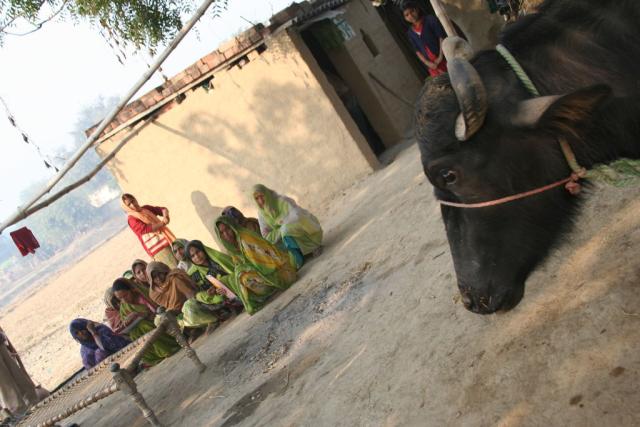
Second, the amount of the loans are very small.  For example, the loans at Cashpor are typically in the $100-$200 range, with the maximum loan topping out at around $350 per year.  This may sound like a paltry sum, but you have to realize that the average daily wage of the very poor in India is around $1 per day!!!  Let me repeat that – $1 per day!!! These funds are used for various purposes, with many of the borrowers using the funds to open up a small shop in the village or, in the villages served by Cashpor, to buy a buffalo (whose milk they sell in order to repay the loan).
small_big_3
Third, the loans are only given to individuals who are part of a group, usually consisting of 10-20 members.  The group is formed by the women in the village, and new members (i.e., individuals who will receive loans) must be approved by the group in addition to the MFI.  The group members vow to help pay the loan of a member who, for whatever reason (e.g., the buffalo they bought dies), is unable to pay.
small_big_1
MFIs have been very successful.  The collection rate for loans is typically in the high 90% range, a rate that would be the envy of any bank in the world; in fact, many banks are realizing the opportunities that exist in this market (as noted below).  Most importantly, the effects these small loans have on the villages that receive them are dramatic.  While the villagers are still poor by our standards, they have used the income they’ve produced from these loans to improve their quality of life, building more protective homes (e.g., graduating from a simple tent to a home with mud walls), improving their nutrition and health and educating their children.

During our two days of volunteer work, we feel like we were able to add true value using our respective skill sets.  With my background as a corporate and securities lawyer, I was able to help Cashpor review and negotiate the terms of a transaction with the largest bank in India, who wants to enter the profitable microfinance arena but has decided to outsource its activities to Cashpor instead of starting the business internally.  In addition, we assisted in structuring a new benefit to the borrowers that forgives loans in the event the borrower or her spouse dies during the repayment period of the loan.  As a previous press secretary in the US Senate, Shanna used her media skills to rewrite parts of the annual report that is distributed each year to current and prospective investors of Cashpor.
small_big_2
The highlight of our time with the organization was our visit to one of the villages serviced by Cashpor. We sat in on two different group meetings, led by staff members of Cashpor on a weekly basis.  These meetings allow the villagers to ask questions and voice their concerns, and allows Cashpor to collect the weekly payments (which are recorded in a booklet retained by the borrower).  After the meeting, we took a few photos of the women and the children of the village.  After I showed one kid a picture I took of him on the digital camera, I was swarmed by dozens of other children wanting me to take their photo and show them the result.  We’ll never forget the smiles on their faces.

[embedplusvideo height=”350″ width=”450″ editlink=”http://bit.ly/1t0stCK” standard=”http://www.youtube.com/v/GyL6zBU2GjM?fs=1″ vars=”ytid=GyL6zBU2GjM&width=450&height=350&start=&stop=&rs=w&hd=0&autoplay=0&react=1&chapters=&notes=” id=”ep2114″ /]

a_golden_2
Tourists come to Amritsar primarily for two reasons – to visit the Golden Temple sacred to the Sikh religion and to watch the closing ceremony at the border crossing between India and Pakistan.  After a 7-hour train ride from Delhi, we checked into our hotel with the goal of checking these two activities off our list the next day.

The Sikh religion is relatively new compared to the other predominant world religions.  Sikhism began in the 15th century when Guru Nanak became dissatisfied with the Hindu religion, primarily due to its acquiescence to the caste system that pervades Indian society.  The Guru believed that all should be treated equal, regardless of birth.  The Guru’s teachings (and the teachings of the 9 other Gurus that followed him) are written down in the Sikh holy book, the Guru Granth Sahib.
a_golden_5
While the religion’s followers are a small minority in India (and virtually unknown to the rest of the world), they have played a large role in recent Indian history.  In response to repeated persecution by other religious groups (predominately Muslims in present-day Pakistan and nearby Afghanistan), Sikhs learned the art of warfare and became respected as great warriors throughout India; in fact, many of the leaders of the Indian army are Sikhs.  Male Sikhs are easily recognized by the turban worn to cover their head and a typically long beard (one of the customs of Sikhs is to never cut their hair). Shanna’s father’s family is Sikh, so our visit to Amritsar had particular importance.

After covering our heads and removing our shoes, we entered the Golden Temple complex.  The Temple is a stunning site, covered with over 1,500 pounds of gold that sparkles throughout the day and night (with the help of spotlights).  The Temple is surrounded by a pool of water considered holy by Sikhs – it is said to have cured diseases of devout followers.  Inside the relatively small temple, priests and musicians take their turns throughout the day chanting scripture from the holy book, which is broadcast on loudspeakers throughout the complex and on cable tv throughout India.
a_golden_3
One of the most noteworthy practices of Sikh temples (called gurdwaras) is langar – the free meals that are offered at all gurdwaras to anyone regardless of religion, caste or nationality.  The langar at the Golden Temple, which is run by volunteers, is massive – approximately 40,000 people dine here for free each day (donations, of course, are accepted, but not at all obligatory).  We were able to tour the impressive operation required to feed this mass group, and to eat a simple lunch of chapati, dhal and rice.  They even let me attempt to cook some of the chapatis (Indian flat-bread); my service was short-lived considering my skills at flipping the chapatis and transporting them to a basket were woefully inadequate (at least seven of the chapatis ended up on the floor; luckily, it appears that the five-second rule applies at the Temple since they were quickly placed in the basket alongside the non-soiled chapatis).
a_golden
That afternoon, we made our way to the nearby India/Pakistan border.  While India shares a huge border with Pakistan, the crossing near Amritsar is the only one currently open.  On each side of the border, football-style bleachers have been erected for the thousands of people (mainly Indians; the Pakistan bleachers were nearly emptly, possibly related to the current political turmoil of the country) who come to watch the enigmatic border-closing ceremony each evening.

Shortly after we were escorted to the VIP section of the bleachers (oddly, foreigners are given the best seats at this pro-India event), the 20-minute ceremony began.  The border guards on each side of the gate took their turns marching to and from the border, atte
a_golden_4
mpting to look as intimidating as possible; however, their flamboyant style and dress looked more like something out of a Monty Python movie. Particularly amusing was the Rockette-style kicks they executed with regular precision.

Eventually, the gate was open and the opposing guards stood chin to chin in a staring contest.  After a couple of minutes, the stares were broken, the flags of each country were lowered in unison and the border was closed for the evening.  Throughout the event, the crowds on each side of the border chanted nationalistic songs with the fervor of fans at a Duke/Carolina basketball game.  Restrained by Shanna, I was unable to start a “Taste Great – Less Filling” cheer or to introduce the wave to India – the only negative of my visit to Amritsar.

Golden Temple Video:

[embedplusvideo height=”350″ width=”450″ editlink=”http://bit.ly/1t0sQ04″ standard=”http://www.youtube.com/v/0Z0SLNINHVY?fs=1″ vars=”ytid=0Z0SLNINHVY&width=450&height=350&start=&stop=&rs=w&hd=0&autoplay=0&react=1&chapters=&notes=” id=”ep5554″ /]

Border Closing Ceremony Video:

[embedplusvideo height=”350″ width=”450″ editlink=”http://bit.ly/1t0t0od” standard=”http://www.youtube.com/v/48GpqYFHgcE?fs=1″ vars=”ytid=48GpqYFHgcE&width=450&height=350&start=&stop=&rs=w&hd=0&autoplay=0&react=1&chapters=&notes=” id=”ep2684″ /]

a_cry_1
While travel has innumberable benefits, one of the greatest is perspective.  When you see how others live and the challenges they face, you can better understand your place in the world.  Although I’ve visited many places, I’ve never found a better place to learn perspective than in India.  I’ve always said that I wish all Americans could spend just a few hours in India so they could realize how blessed most Americans are.

Shanna’s father is involved with an organization called CRY, a non-profit whose primary goal is to provide education to children in India who would otherwise go without.  CRY has projects throughout India, including several in Delhi.  Using his contacts, Shanna’s father organized a trip to one such project for me, Shanna and her parents.
a_cry_2
Quickly after turning off a main road outside Delhi, we came upon a slum area like nothing I’ve ever seen.  The ground was a dry, dusty dirt that looked as if it hadn’t seen water in years, and the “homes” were makeshift tents that had been built with scraps found in the garbage dump located a few hundred yards away.  As we walked through the village, we were swarmed by children and intrigued adults whose clothes were mostly ripped and filthy dirty.  Many of the children were without clothes at all, and shoes were a luxury in which few had the means to indulge.  Our hearts sank.

The representatives of CRY, including one of the teachers from the village, led us around this village and two others within walking distance.  The villages are mostly made up of nomadic people who have left their prior homes and made their way to Delhi in search of a better life.  If this way of life is any improvement to their prior one, I can’t even begin to picture what that one must have been like.  The villagers spend their days attempting to make money any way they can, including “ragpicking,” where they sift through the garbage left at the dump next to the village in hopes of finding anything of value. In a perverse manner of environmental service, much of their success in ragpicking includes finding and selling recyclable goods (such as plastic water bottles).  The remainder of their time is consumed with basic survival, including the daily carrying of water jug by jug from a nearby water source with – to say the least – questionable sanitation levels.
a_cry_3
In these villages, where basic needs are barely met, education of children is an afterthought.  Many of the children start trying to earn money for their families – including by way of begging – soon after they’re able to walk.  In some cases, parents have to be convinced that education is a valuable use of their child’s time.  After all, every hour in school is another hour where money is not made (and food purchased with that money is not put on the table).

With its funds, CRY has set up schools in each of the three villages we visited.  In one case, the school met under a tent; in the other two, children learned in a windowless stone hut.  Noticeably absent were any of the items you see in most classrooms in America: no computers (you need electricity for that…), no chairs and no desks. Some of the children simply had a small chalkboard and a piece of chalk – we were told that this was preferred to pencils and paper because a constant supply of paper would be cost-prohibitive.

Even with these seemingly insurmountable hurdles, the smiles on the children’s faces were impossibly big.  They took turns singing us songs they had learned in school, most of which were laden with inspirational lyrics.  Shanna’s mom, a pre-school teacher in Michigan, taught a few songs to the children.  They were quick learners and seemed starved for interaction.  As we made our way out of the village, we passed by one of the classrooms where the children were sitting outside in a circle (on the dirt, of course) and playing a modifed version of duck, duck, goose – a playful escape from their dim reality.

We all came away from the experience with deep appreciation for the life we have at home, sadness for the inhabitants of these villages, disbelief that this can exist just a few miles from the opulence that exists in parts of Delhi, guilt for the excesses of our lives and resolve to support organizations like CRY.

[embedplusvideo height=”350″ width=”450″ editlink=”http://bit.ly/1t0uvmg” standard=”http://www.youtube.com/v/decme_1ihZU?fs=1″ vars=”ytid=decme_1ihZU&width=450&height=350&start=&stop=&rs=w&hd=0&autoplay=0&react=1&chapters=&notes=” id=”ep1665″ /]

postcard3
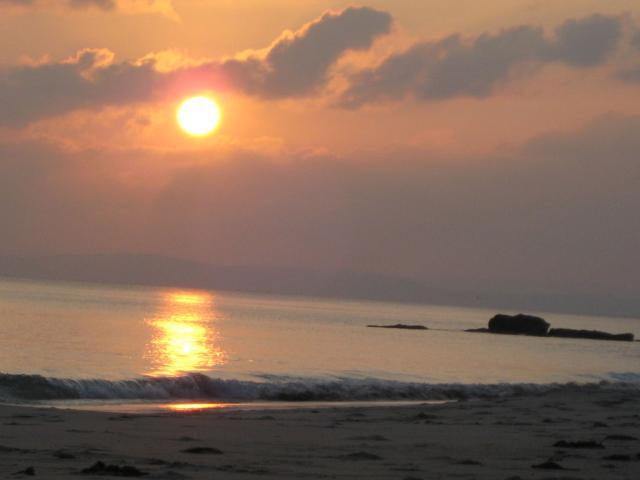
It’s a unique experience when you realize you’ve discovered perfection.  Seconds after crossing through the tropical forest abutting the beach and dipping our toes in the poster-board white sand, Shanna and I looked at each other with all-knowing eyes.  We instantly knew that we had just stepped onto the most beautiful beach in the world.

The Andaman Islands have been on my travel radar-screen for several years; I’ve long heard stories of their remoteness and untouched underwater treasures.  Their location in the middle of the Bay of Bengal – east of India, south of Burma and west of Thailand – has kept tourists away thus far.  The only real influx of people onto the islands was during the early 20th century, when the British capitalized on the islands’ remoteness by establishing prisons here to house Indian revolutionaries during the British colonial period.
postcard2
Shanna and I had no intention of visiting the islands on this trip.  In fact, it wasn’t until I thumbed to the back of my India guidebook that I realized that the islands were a part of India and accessible by airplane from a nearby city.  Luckily, tickets were available, and we were on our way.

After landing in the capital city of Port Blair, we quickly made our way to the jetty where we caught a 2 1/2 hour ferry to Havelock Island, one of the only islands in the Andaman archipelago with any tourist facilities at all.  Upon reaching shore, we caught a taxi for a 20 minute ride to our beachside cottage at Beach No. 7. (Unimaginatively named, the beaches share the same number as the nearest village.) Soon thereafter, we made our way to the beach and stumbled upon paradise.

What makes the perfect beach?  A combination of crystal-clear water with countless tints of turquoise depending on the positioning of the sun in the sky; impossibly white sand free of rocks, flotsam and, of course, litter; waves that rise to a level to produce ample sound as they crash near the beach, but not so violent as to incite occasional fear for one’s safety; a slant to the ground that enables you to walk down a gentle, smooth slope to the ocean and quickly immerse yourself in the ocean waves; a backdrop that includes a towering tropical forest instead of t-shirt shops and high-rise hotels; a complete absence of boats, jet skis or planes dragging signs advertising $5.99 seafood buffets or 2-for-1 drink specials; a water temperature that is refreshingly cool, allowing you to swim comfortably for hours on end without feeling hot or cold; virtually no other beachcombers and zero beach salesmen harassing you with offers of massages, Rolex watches, sarongs, ganja or any other item that they think you’d be interested in; active marine life on the beach, including hermit crabs and seashells with their inhabitants still alive and on the move; and a westward position providing sunsets that quiet all voices. Yes, Beach No. 7 was all of these things and more.
postcard4
After standing in disbelief at the beach on which we were going to spend the next 4 days, we went to dinner at our hotel.  As we placed our order, someone from the hotel notified us that a leatherback turtle was on the beach laying her eggs–an event that biologists wait lifetimes to witness.  Without hesitation, we grabbed our flashlight and headed back to the beach.  It was completely dark other than the faint light of the millions of stars overhead as we walked down the beach searching for the ancient creature.  After a few minutes, we came upon the giant turtle–clearly exhausted after climbing up the beach and digging a hole in the sand in which to lay her eggs, which should hatch into mini-turtles in a month’s time.
postcard1
Slowly, the eggs were laid and the process of burying the eggs began.  With alternate strokes of her rear flippers, the sand was professionally shifted to fill the hole.  Once complete, she began the seemingly endless process of turning her giant frame back toward the ocean and then crawling the 100 feet back to the cool waters of the Bay of Bengal.  On several occasions, I wanted to lend her a hand, but my years of viewing the Discovery Channel and Animal Planet have taught me otherwise.  When the turtle finally reached the water and swam out of view, Shanna and I both knew that we’d experienced something that could not be bought.

It was hard to imagine any other experience that could make our stay better than it already was, but it came after a long boat ride to an isolated island off the coast of Havelock Island.  Shortly after deflating our BCDs (Buoyancy Control Devices) and descending 45 feet under the sea, we were rewarded with coral so colorful it would make a clown blush.  Unlike many places where I’ve dived, the coral was full of life – no signs of clumsy divers or uncaring fishermen destroying the reef.  The many reefs were supported by a seemingly endless variety and number of fish and other aquatic creatures.  After witnessing such a display of life under the sea, I came away from the dive site feeling small and insignificant.

When we boarded the ferry to leave the islands, I was struck with great disappointment that our time here was finished, but also a sense of pride as a traveler for finding an unblemished paradise.  Havelock Island is nature at it finest.

[embedplusvideo height=”350″ width=”450″ editlink=”http://bit.ly/1t0vHGh” standard=”http://www.youtube.com/v/FZ0ly3Ml8OY?fs=1″ vars=”ytid=FZ0ly3Ml8OY&width=450&height=350&start=&stop=&rs=w&hd=0&autoplay=0&react=1&chapters=&notes=” id=”ep5737″ /]